What is Oxagon, and what will it cost?
This marks the inaugural section of a research article discussing the proposed floating city, Oxagon, which is one of the key developments under the Saudi Vision 2030 initiative. Our exploration of Oxagon spans from a macro to a micro perspective, with the goal of shedding light on this ambitious endeavor.
According to ABI Research, investments in the “New Vision for Cities” will reach $375 billion by 2030. On the other hand, Deloitte values the “annual profit pool” for disruptors in the construction industry at $265 billion.
This article is a contribution from the LAIA Observatory, a territorial research unit specializing in market trends and quantitative analysis.
Saudi Vision 2030 — A Grand National Vision
Oxagon is a significant component of a more extensive initiative known as Saudi Vision 2030. This visionary plan was developed by the Saudi Crown with the aim of diversifying the nation’s economy away from its heavy dependence on oil. Notably, Salman Bin Abdulaziz Al-Saud and Mohammed bin Salman have unveiled 47 key projects as part of this transformative agenda, with Oxagon being just one of them. This underscores the leadership’s unwavering commitment to ensuring the sustainability and fostering innovation within the nation, not only in the 21st century but also beyond.
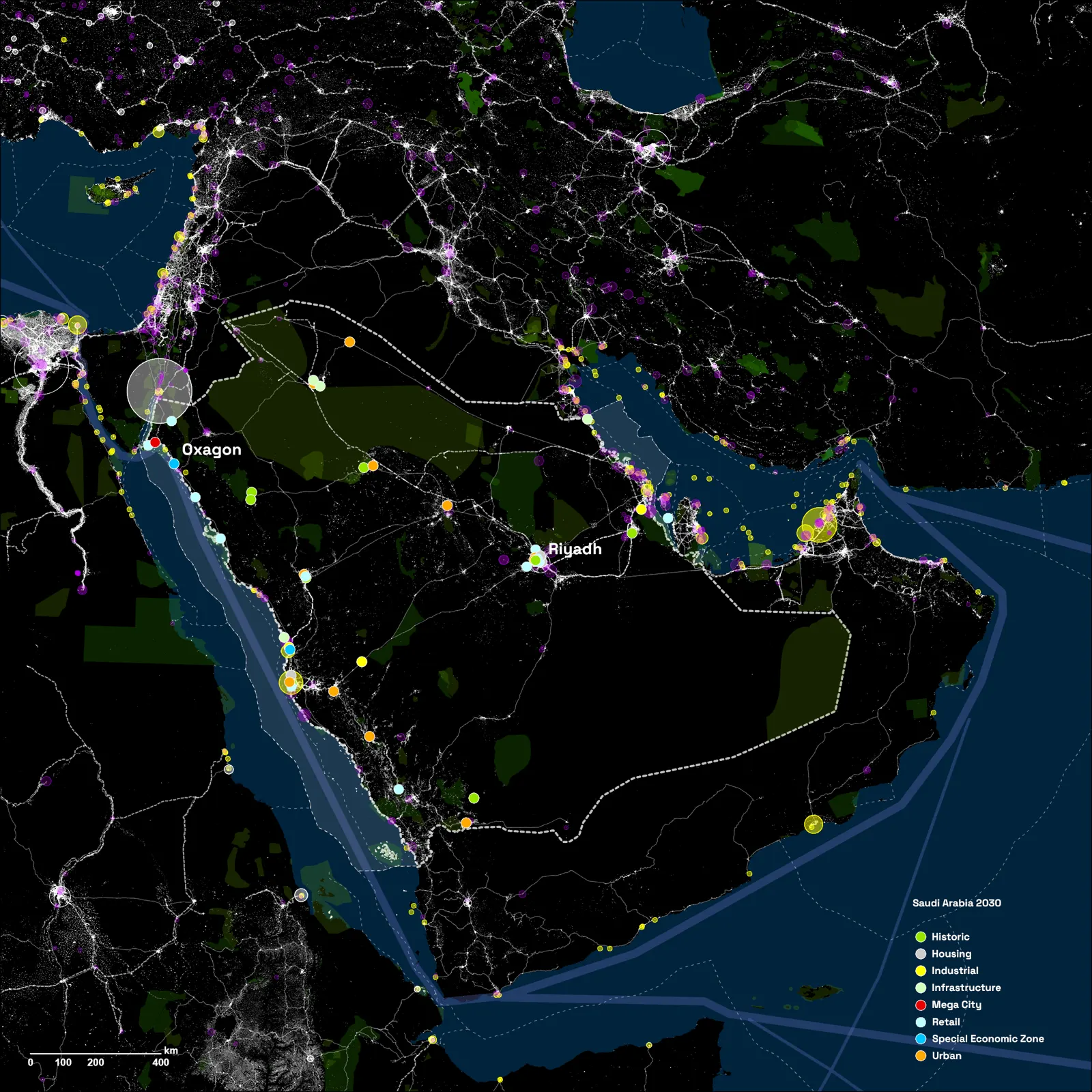
NEOM — The Development Region of Oxagon
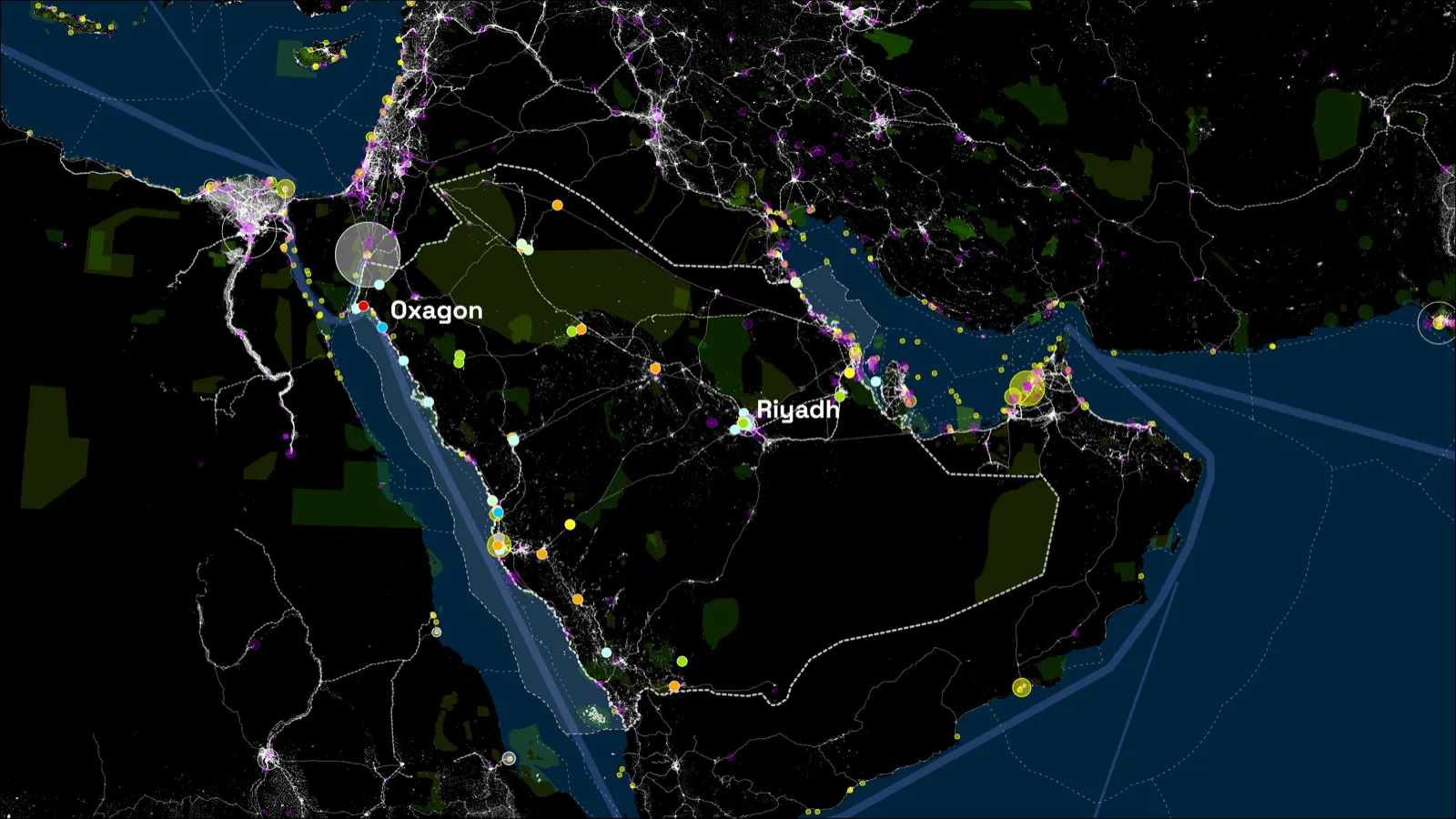
Oxagon is located in the northwest of the Arabian Peninsula, specifically within the Tabuk Province. This province is a crucial part of the Saudi Vision 2030 initiative, known as NEOM, which is established as a special economic zone. NEOM’s special status allows it to attract investments and businesses to the region through a dedicated tax plan.
NEOM’s strategic location positions it as Saudi Arabia’s main trade center. It’s placed where three continents meet, right next to the Suez Canal — one of the world’s busiest trade routes, handling 13% of global trade. It is located adjacent to major trade routes like the Maritime Silk Road and the incoming India-Middle East-Europe Economic Corridor. Furthermore, NEOM capitalizes on its position in a militarized region, long serving as a significant military hub for the country since the Gulf War.
Public sources estimate the construction costs for NEOM to be approximately $500 billion. However, an article in the Wall Street Journal has indicated that the construction of the Mirror Skyscraper alone, part of the NEOM development, is projected to cost $1 trillion. This revelation suggests that just one of the four major developments within NEOM will surpass the initially announced total cost for the entire NEOM project.
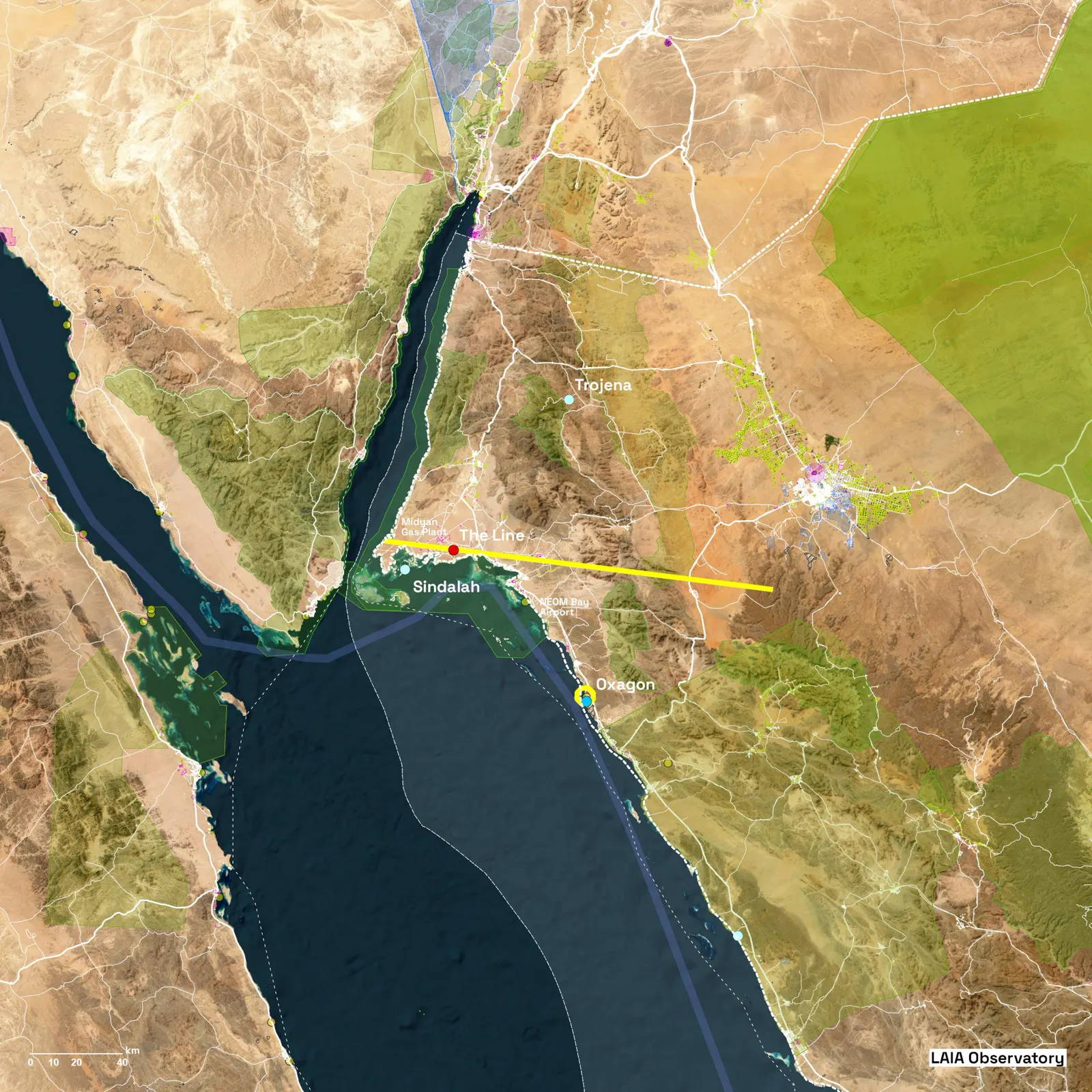
Oxagon — Cost Evaluation and Quantitative Comparison
Oxagon is poised to become the primary industrial port for NEOM and the entire Saudi Vision 2030 initiative. In fact, the Duba Port has been in operation in this region since 1994. The transformation begins with the renaming of the Duba Port to the Port of NEOM. By 2025, it aims to become the first advanced terminal, signifying its transition into a fully automated port with a seamlessly integrated digital supply chain platform.
The costs of Oxagon and other projects within the Saudi Vision 2030 initiative are not clearly disclosed in public sources. However, these cost estimates hold great significance for entities looking to initiate ventures in the region, demanding quantitative data for informed decision-making. To provide clarity and demystify these figures, LAIA’s Observatory conducts a quantitative comparison to estimate the construction costs of Oxagon and other projects under the Saudi Vision 2030.
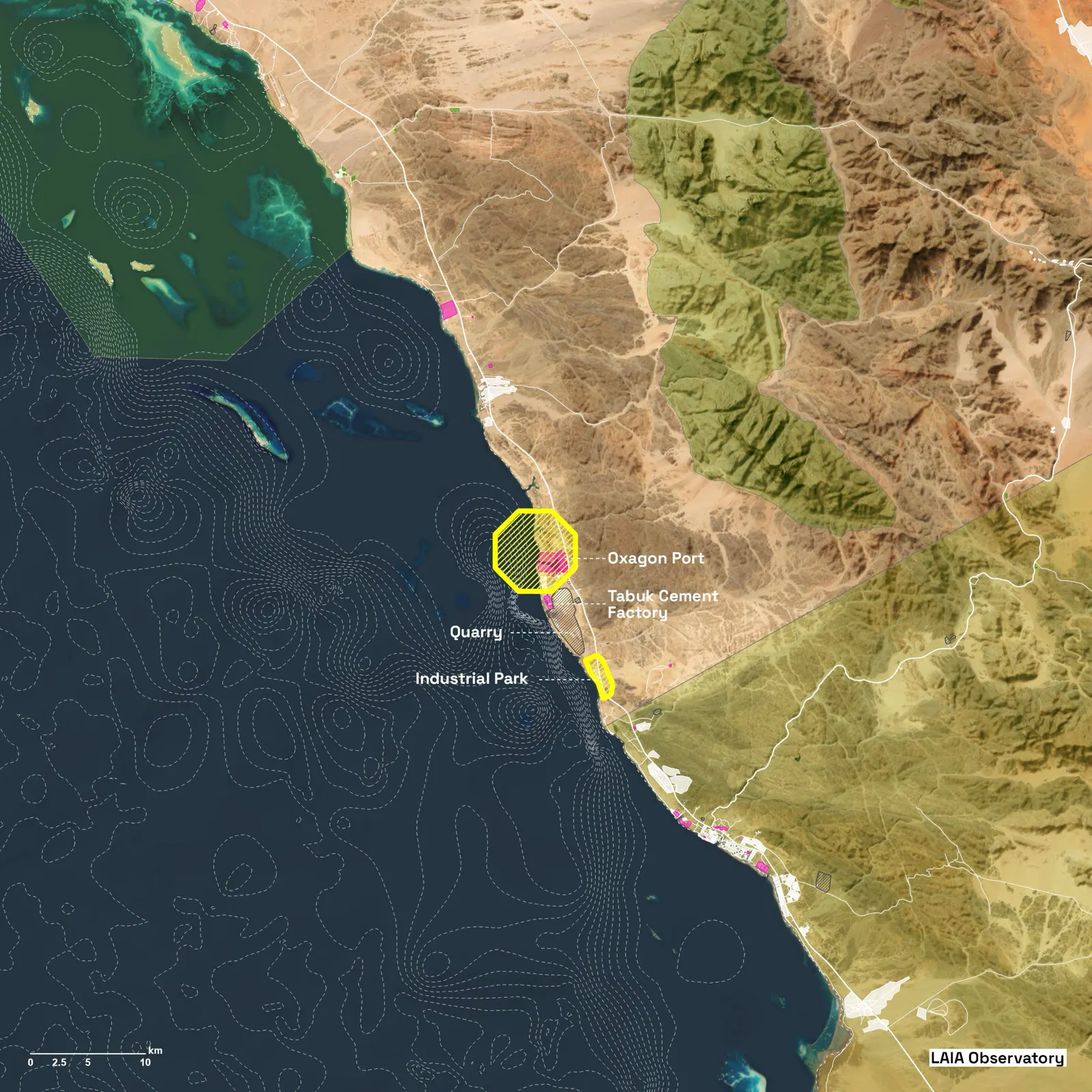
Cost Estimation of Oxagon:
This new city is set to cover an area of approximately 40 km² and is projected to accommodate around 90,000 people by 2030. This results in a population density of 2250 inhabitants per km², classifying it as a medium-density city. This makes sense, given its primary purpose as the industrial port for the national project. For reference, Riyadh, the capital city of Saudi Arabia, hosts around 3600 inhabitants per km².
Half of Oxagon will float on the Red Sea at an average depth of about 10 meters, and it is designated to become the “world’s largest floating structure.” Considering that construction costs for offshore structures tend to be significantly higher than those on the mainland, we have divided the estimated costs into two categories. This approach leads to a total estimated cost of $33 billion for building Oxagon.
Oxagon actively participates in the Future Factories Programme, an initiative by Riyadh aimed at removing barriers to industrial capabilities. This agreement also establishes a framework for cooperation in the development and implementation of the Advanced and Clean Manufacturing Improvement Tool. This tool enables organizations to assess their readiness for change and transition toward advanced manufacturing systems and processes.
Currently, NEOM’s workforce is dedicated to attracting young talent, with 40% of their employees being young Saudis who have received top-tier education abroad. The city continues to draw young talent, especially in the fields of AI and Robotics, as evidenced by the focus of the Oxagon hackathon.
Other areas of interest within the hackathon include Big Data Analytics, Advanced Sensing, IoT, Material Science, Nano Technology, and Automated Guided Vehicles, and Drones.
Partners
In addition to investment partners for the development of this monumental project, NEOM is collaborating with various entities to expand and promote their Saudi Vision 2030 worldwide while continuing to attract talent. As an example, McLaren has joined forces with NEOM to establish a Formula E team. Additionally, they have partnered with Oxagon to inaugurate a research and innovation campus in 2025, as part of the McLaren Accelerator program. NEOM will also be the host city for the 2029 Asian Winter Games in TROJENA.
Masterplan
NEOM’s masterplans are characterized by their pure geometrical shapes, as exemplified by projects like The Line, a 170km straight line cutting through the desert, and Oxagon, an octagon-shaped city divided between land and offshore. The offshore portion consists of water-filled floating squares connected by small canals, with a spacious channel designed for ships to navigate through.
The Danish architectural firm BIG — Bjarke Ingels Group was announced as the master planner for Oxagon during the Venice Architecture Biennale’s exhibition titled “Zero Gravity Urbanism.” This exhibition was curated by Ramon Part and produced through a collaboration between Squint Opera and We Exhibit.
During the exhibition, several other architectural offices were unveiled as collaborators, including Adjaye Associates, Coop Himmelb(l)au, Delugan Meissl Associated Architects, Studio Fuksas, Luca Dini Design and Architecture, and Studio LAVA.
Conclusion
NEOM’s mega projects often captivate attention due to their innovative design and ambitious cost estimates, which can at times appear implausible with their unconventional planning and construction methods. Nonetheless, these projects play a crucial strategic role in advancing Saudi Arabia’s national vision.
With the right construction elements and methodologies, Oxagon has the potential to be executed within the estimated budget of under $33 billion. In an upcoming article, The Observatory will provide a more in-depth exploration of Oxagon’s construction and development.
Let us know your thoughts and contact us if you would like to know more at www.laia.org
Originally published on Medium on 5 October 2023: read the original.