Dedicated Freight Corridors of India (DFC)
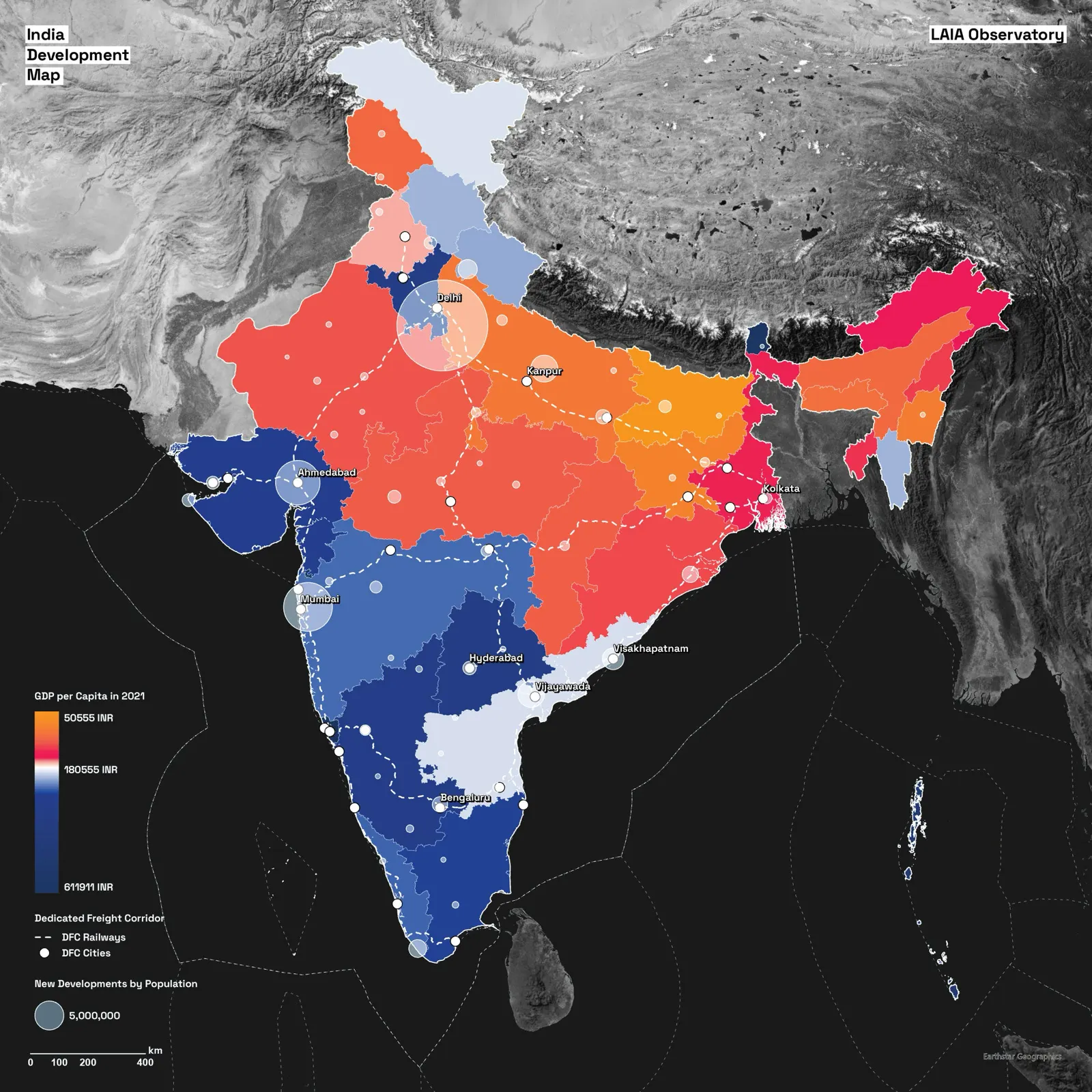
India’s DFC represent a cornerstone in the nation’s vision to redefine its freight transportation paradigm. These meticulously planned infrastructure projects are poised to provide high-capacity, exclusive rail routes designed for swift and efficient goods movement throughout India. Encompassing a series of corridors, each is tailored to cater to distinct regions and pivotal trade channels.
In the larger global context, the emergence of the India-Middle East-Europe Economic Corridor (IMEC) initiative further augments the strategic importance of India’s DFCs. The IMEC, envisaged as a transformative economic and geopolitical venture, promises to integrate seamlessly with the DFC infrastructure, magnifying their collective impact. The synergy between the DFCs and IMEC not only reinforces India’s position in global logistics but is also anticipated to hasten the deployment and realization of the DFCs, making them even more integral to India’s future trade and economic landscape.
Proposal and Planning
The idea for dedicated freight corridors in India was conceived in 2005, culminating in the establishment of the Dedicated Freight Corridor Corporation of India Limited (DFCCIL). The organization was mandated to plan, construct, and operate dedicated freight corridors throughout the nation. Initially, the plan concentrated on the Eastern Dedicated Freight Corridor (EDFC) and the Western Dedicated Freight Corridor (WDFC). Over time, four more corridors were proposed: the North-South Dedicated Freight Corridor (NSDFC), East-West Dedicated Freight Corridor (E-WDFC), East Coast Dedicated Freight Corridor (ECDFC), and South-West Dedicated Freight Corridor (SWDFC).
Detailed Overview of the initial Six Corridors
- Eastern Dedicated Freight Corridor (EDFC): Spanning a length of 1,856 km, the EDFC comprises two segments. The first is an electrified double-track segment of 1,409 km connecting Dankuni in West Bengal to Khurja in Uttar Pradesh. The second is an electrified single-track segment of 447 km linking Ludhiana in Punjab to Dadri in Uttar Pradesh, passing through the state of Haryana.
- Western Dedicated Freight Corridor (WDFC): Covering a route length of 1,504 km, this corridor extends from Dadri in Uttar Pradesh to Jawaharlal Nehru Port Trust (JNPT) in Mumbai, Maharashtra. It aims to accommodate high-speed freight trains and decongest the existing network.
- North-South Dedicated Freight Corridor (NSDFC): Proposed to connect Delhi and Chennai, this corridor is planned to be approximately 2,327 km long. It will traverse the states of Uttar Pradesh, Madhya Pradesh, Maharashtra, Andhra Pradesh, and Tamil Nadu.
- East-West Dedicated Freight Corridor (E-WDFC): This proposed corridor is designed to link Kolkata and Mumbai, covering an estimated distance of 2,328 km. The corridor will pass through the states of West Bengal, Jharkhand, Bihar, Uttar Pradesh, and Maharashtra.
- East Coast Dedicated Freight Corridor (ECDFC): Planned to connect Kharagpur in West Bengal to Vijayawada in Andhra Pradesh, this corridor will cover approximately 1,114 km. The route will pass through the states of West Bengal, Odisha, and Andhra Pradesh.
- South-West Dedicated Freight Corridor (SWDFC): Proposed to link Chennai in Tamil Nadu with Goa, this corridor is expected to cover approximately 1,483 km. It will traverse the states of Tamil Nadu, Karnataka, and Goa.
Construction and Timelines
India’s dedicated freight corridors are monumental projects involving intricate engineering work, substantial land acquisition, and significant coordination among multiple stakeholders. Construction for these corridors has been phased and targets different completion timelines for each.
Already Under Construction
- Eastern Dedicated Freight Corridor (EDFC): Spanning 1,856 km, this corridor connects Dankuni in West Bengal to Khurja in Uttar Pradesh. Parts of this corridor between Dankuni and Khurja are already operational. The full corridor is under active implementation and is projected to be commissioned by 2024.
- Western Dedicated Freight Corridor (WDFC): Covering approximately 1,504 km, this corridor links Dadri in Uttar Pradesh with Jawaharlal Nehru Port Trust (JNPT) in Mumbai, Maharashtra. The first phase was completed in 2019. A 306 km section between Dadri and Phulera became operational in 2020, and full commissioning is expected by 2023.
In Planning and Pre-Construction Stages
- North-South Dedicated Freight Corridor (NSDFC): Proposed to connect Delhi and Chennai, this corridor is still in the planning stage. The detailed project report has been prepared, but it is still awaiting approval and implementation.
- East-West Dedicated Freight Corridor (E-WDFC): Intended to connect Kolkata and Mumbai, the survey work for this corridor is complete, but the project still awaits approval.
- East Coast Dedicated Freight Corridor (ECDFC): Connecting Kharagpur and Vijayawada, this corridor has received in-principle approval. Pre-construction activities like surveys and environmental assessments are underway, but major construction work has yet to commence.
- South-West Dedicated Freight Corridor (SWDFC): Proposed to run between Chennai and Goa, this corridor is still in the conceptual stage. Detailed project studies have yet to be commissioned.
Costs and Financing
The construction of India’s dedicated freight corridors represents a significant financial commitment, characterized by capital-intensive investments. The original estimated cost of constructing the entire network was approximately USD 20 billion. However, these cost projections have undergone upward revisions. As of April 2022, the cost of the Dedicated Freight Corridors (DFC) increased by an additional Rs 385 billion (approximately $5.2 billion), signaling a shift in the funding model as well.
Funding Sources and Collaboration
Funding for these corridors comes from a mix of sources, involving a complex interplay of debt and equity. The funding model stipulates a 2:1 debt-equity ratio. Approximately 67% of the construction costs for the Western DFC are funded by a soft loan, primarily sourced by the Government of India and from international agencies:
- Japan International Cooperation Agency (JICA): JICA has been a significant contributor, providing both financial aid and technical expertise for the construction of the dedicated freight corridors.
- World Bank: Another key player in the financing landscape, the World Bank approved loans specifically earmarked for corridor sections. For instance, it approved a loan of $975 million for the Khurja-Kanpur section and another loan of $1.1 billion for the Kanpur-Mughalsarai section in 2011 and 2014, respectively.
Additional financing and Implications
To cover the shortfall between the project costs (excluding the cost of land) and the loans from international agencies, the Indian Railways has provided equity contributions. These contributions help ensure that the project remains financially viable while balancing the ratio of debt to equity.
The evolving costs and participation of multiple financial stakeholders indicate that these projects are not just infrastructure upgrades, but also complex financial endeavors. They have necessitated collaboration among domestic and international agencies and have showcased India’s ability to secure and manage large-scale infrastructure financing.
With the recent unveiling of the India-Middle East-Europe Economic Corridor (IMEC), there lies an amplified potential for more foreign investments and financial collaborations. The strategic alignment with IMEC can be seen as a catalyst, likely attracting stakeholders interested in investing in this broader vision of interconnected trade and infrastructure. This holistic view can lead to more favorable financing terms and a possible influx of supplementary financial resources. Such collaborations further consolidate India’s position, not just as an infrastructural powerhouse but also as a strategic pivot in global economic and geopolitical realignments.
Technologies and Features
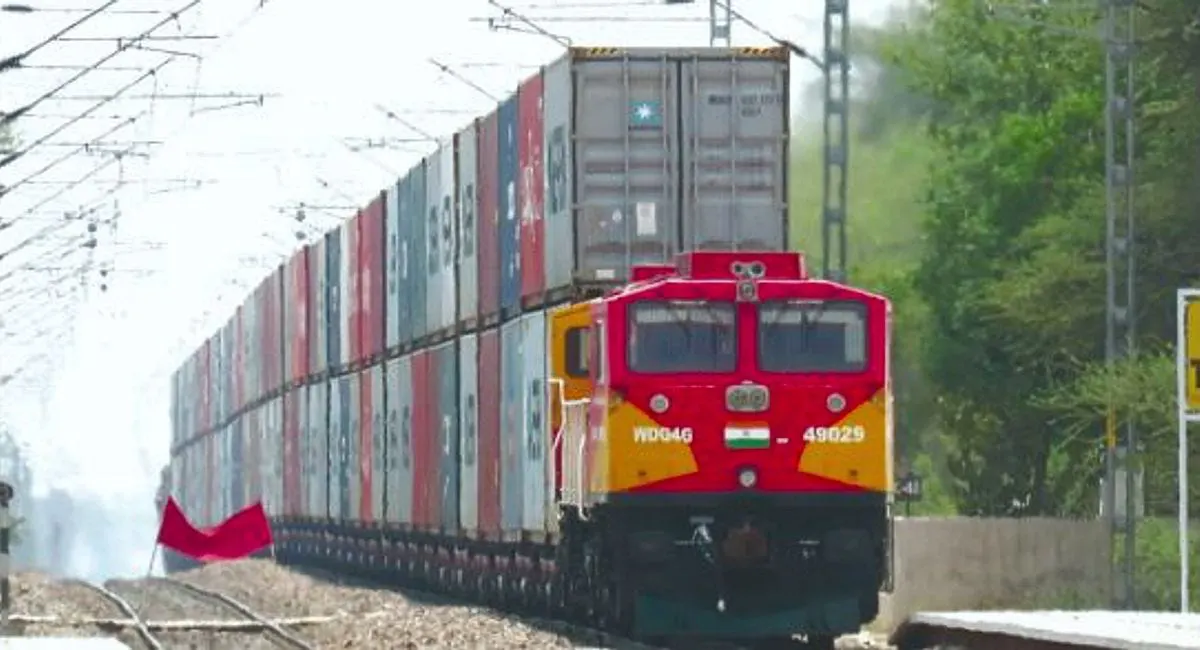
India’s Dedicated Freight Corridors are being built with a focus on utilizing modern technologies and design features to achieve new levels of efficiency, safety, and capacity in the country’s freight transportation system. Here are the key technologies and features being incorporated:
- High-Speed Rail: The corridors are engineered to accommodate high-speed freight trains, which could potentially operate at speeds up to 100 km/h, allowing for faster transit times and increased throughput.
- Electric Traction: The use of electric traction systems not only reduces the carbon footprint but also lowers energy consumption compared to traditional diesel locomotives. This is in line with India’s sustainability goals and its commitments to reducing greenhouse gas emissions.
- Dedicated Freight Terminals: To facilitate seamless loading and unloading operations, specialized freight terminals are being developed at strategic locations along the corridors. These terminals are equipped with advanced machinery for efficient material handling.
- Advanced Signaling and Communication: State-of-the-art signaling and communication systems, including Centralized Traffic Control (CTC) and Automatic Train Control (ATC), are being deployed. These systems aim to minimize human errors and enhance operational safety.
- Double Stacked Container Trains: The corridors are designed to accommodate double-stacked container trains, a feature that significantly maximizes the capacity for containerized freight transportation. This is especially beneficial for sectors that rely heavily on shipping goods in containers, such as manufacturing and e-commerce.
- Train Protection and Warning System (TPWS): An advanced system designed to prevent collisions and improve safety by continuously monitoring train speed and track conditions.
Impact and Benefits
Economic and Logistics Impact
- Enhanced Connectivity: The corridors are strategically planned to connect major industrial and consumption centers across India, which should promote balanced regional development and adapt to changing industrialization patterns.
- Reduced Transit Times: Given the prioritization of passenger trains on existing networks, the DFCs aim to dramatically improve the speed and punctuality of freight trains, which will, in turn, enable just-in-time deliveries and improve supply chain efficiency.
- Boost to Trade and Commerce: The DFCs are expected to be a game-changer for India’s logistics sector, enhancing the overall efficiency of goods movement and thereby boosting trade and commerce.
System Efficiency and Capacity
- Decongestion of Existing Railways: One of the most critical issues facing the Indian railway system is congestion. By diverting freight traffic to dedicated corridors, there will be a significant reduction in congestion on existing networks.
- Addressing Capacity Constraints: The Ministry of Railways has fast-tracked the implementation of the DFCs specifically to ease the capacity constraints plaguing the current rail infrastructure. Insufficient investment and technological upgradation have been long-standing bottlenecks to growth in rail freight traffic, which the DFCs aim to resolve.
Environmental Benefits
- Sustainability: The use of electric traction systems and other eco-friendly technologies within the DFCs will contribute to reducing carbon emissions, thus promoting more sustainable transportation systems.
Competitive Edge
- Regaining Market Share: Currently, about 60% of India’s rail network capacity is used for passenger transport, contributing only around 30% of the revenue. The superior design features and increased carrying capacity of the DFCs are expected to give railways a competitive edge over other modes of transport, enabling them to claw back lost freight share and attract new time-sensitive cargo categories.
Future Developments
- Additional Corridors: The success of the current DFCs has led to plans for developing additional corridors linking major locations, ensuring the long-term positive impact of these infrastructures on India’s logistics landscape.
LAIA Observatory Proposal for DFCs Further Development
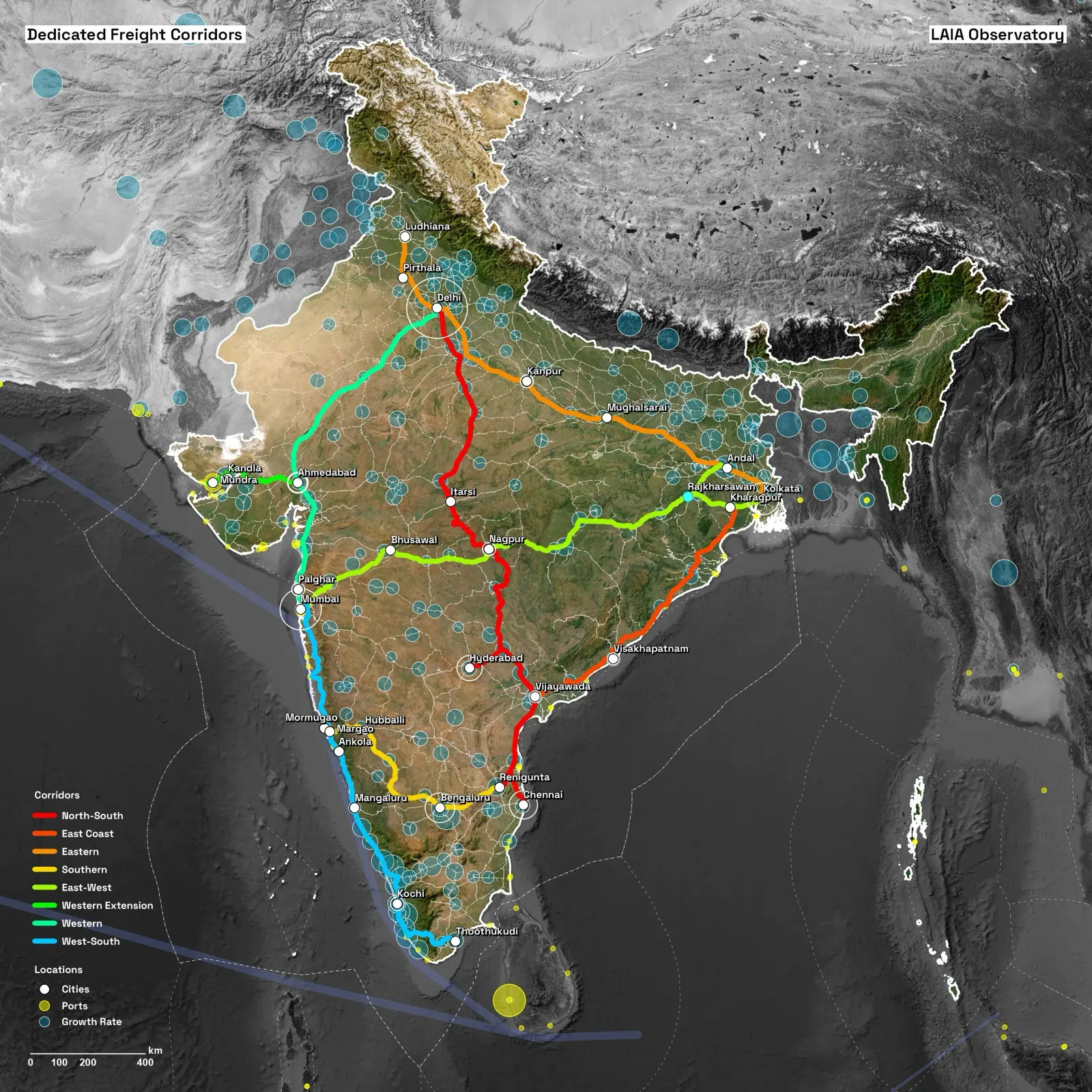
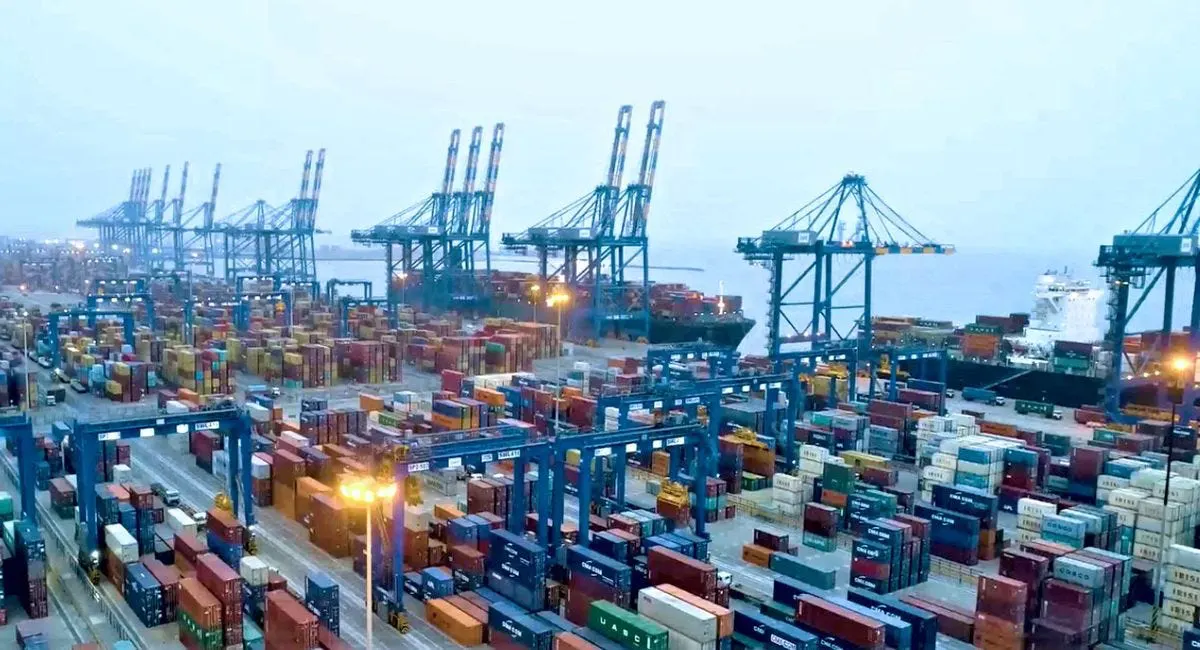
The LAIA Observatory area specialized in infrastructures and regional planning, has conducted extensive research into India’s Dedicated Freight Corridors (DFCs). Based on that, we propose an extension to the existing Western DFC and an additional new corridor to further optimize India’s logistics landscape. These proposals aim to include all 12 of the largest ports in continental India in the Corridors, which until now excluded the ports of Kandla, Mundra, Kochi, and Tuticorin.
Following the recent unveiling of the IMEC (India-Middle East-Europe Economic Corridor), highlighted in a recent LAIA Observatory article, our stance on amplifying the DFCs in the Western region of India has gained even stronger validation. It’s crucial to seamlessly integrate this region’s major ports with the existing DFC infrastructure. Furthermore, there’s an emphasized need to expand the corridor southwards, an area which was notably underserved in the original DFC blueprint.
Please note that: (JC) stands for ‘Junction,’ indicating railway intersections, and (PT) for ‘Port,’ referring to key seaports in the corridor network.
Proposed Extension: Ahmedabad Western DFC Branch
Ahmedabad (JC) to Kandla (PT) and Mundra (PT): We propose a significant extension to the current Western DFC, branching out from Ahmedabad, which will serve as a critical junction in the network. This proposed development is particularly strategic because it aims to connect the current Western DFC, which already links Delhi to Mumbai and its largest port, Nhava Sheva, with two other largest ports in India: Mundra and Kandla. This addition will not only enhance port connectivity but will also further optimize and maximize the utility of the Western DFC, as well as the entire layout.
New Proposed Corridor: West-South Dedicated Freight Corridor (WSDFC)
Palghar (JC)-Mumbai (PT) to Madgaon (JC)-Mormugao (PT), Kochi (PT), and Tuticorin (PT): We propose an entirely new corridor named the West-South DFC, initiating from Palghar, a significant junction near Mumbai. This corridor aims to extend to connect with three critical ports: Mormugao in Karnataka, Kochi in Kerala, and Tuticorin in Tamil Nadu. By doing so, this new DFC would not only serve the broader South of India but would also specifically benefit the regions of Karnataka, Kerala, and Tamil Nadu by enhancing their port connectivity.
Additional Proposals for Enhanced Coverage
To further optimize the utility and reach of the existing and proposed Dedicated Freight Corridors, from LAIA Observatory we propose the following three additional modifications of the Dedicated Freight Corridors masterplan:
- Inclusion of Hyderabad in North-South Corridor (NSDFC): To better serve the Deccan region, we propose including Hyderabad, the capital of Telangana, as a major halt in the North-South Corridor. This inclusion would ideally be situated between Nagpur (JC) and Vijayawada (JC), further enhancing the connectivity of this vital north-south trade route.
- Inclusion of Bengaluru in the Southern Corridor (SDFC): As one of India’s major tech hubs and the capital of Karnataka, Bengaluru should be included as a significant halt in the Southern Corridor. The city would fit strategically between Chennai (PT) and Hubbali, enhancing the corridor’s utility and regional impact.
- Inclusion of Vishakhapatnam in East Coast Corridor (ECDFC): We propose adding Vishakhapatnam (PT), the capital of Andhra Pradesh and the 6th largest port in India, to the East Coast Corridor. This addition would link the port between Haldia (PT), near Kolkata, and Vijayawada (JC), thereby increasing the efficiency and reach of the corridor on the eastern seaboard.
IMEC and its Symbiosis with India’s DFCs
The India-Middle East-Europe Economic Corridor (IMEC), a recently proposed multinational initiative, presents a transformative vision for economic and geopolitical collaboration across three continents. This ambitious endeavor, aimed at reshaping inter-regional connectivity, finds significant synergy with India’s Dedicated Freight Corridors (DFCs). Here, we analyze the intersection of these two monumental projects and the multifold opportunities they present.
A Recap of the IMEC Initiative:
The IMEC, unveiled at the G20 New Delhi summit in September 2023, embodies a collaborative effort involving nations such as India, the United States, the United Arab Emirates, Saudi Arabia, and prominent members of the European Union. The primary intent is to bolster economic growth, foster infrastructure development, and facilitate reciprocal trade agreements, while also countering China’s Belt and Road Initiative (BRI).
Interplay between IMEC and India’s DFCs:
- Strategic Confluence: India’s DFCs, designed to streamline freight transport within the nation, align perfectly with the IMEC’s broader goal of inter-regional connectivity. The two initiatives, working in tandem, can significantly optimize transit routes, linking India’s internal transport hubs with key international destinations.
- Boosting Trade: With IMEC aiming to slash trade time between India and Europe by up to 40%, the efficient connection of DFCs to IMEC’s network can further expedite the movement of goods, promoting India as a significant trade pivot in the global scenario.
- Integrated Infrastructure Development: The ambitious infrastructure features of IMEC, like the transcontinental railway and strategic maritime integration, can seamlessly integrate with the terminus points of DFCs. This ensures not just quicker transit, but also amplifies the overall capacity of both systems.
- Enhanced Port Connectivity: The DFCs’ extension to include major Indian ports will find greater relevance as the IMEC initiative emphasizes maritime connectivity. Ports like Mundra, Kandla, Kochi, and Tuticorin can benefit immensely from the synergized operations of DFCs and IMEC.
- Economic Growth and Regional Development: The complementarity of IMEC and DFCs can stimulate economic growth, not just for India, but for the entire region. It will attract investments, foster industrial growth, and create job opportunities.
- Geopolitical Significance: The alignment of IMEC and DFCs strengthens India’s geopolitical stance. As nations rally behind IMEC as a counterbalance to BRI, India’s pivotal role is amplified by the operational efficiency and reach of its DFCs.
For deeper comprehension, you might read the following articles:
India-Middle East-Europe Economic Corridor (IMEC): An expansive look into the strategic and infrastructural implications of the IMEC.
LAIA Observatory Purpose and Key Functions: To understand the core tenets, objectives, and initiatives spearheaded by our observatory.
Originally published on Medium on 13 December 2023: read the original.