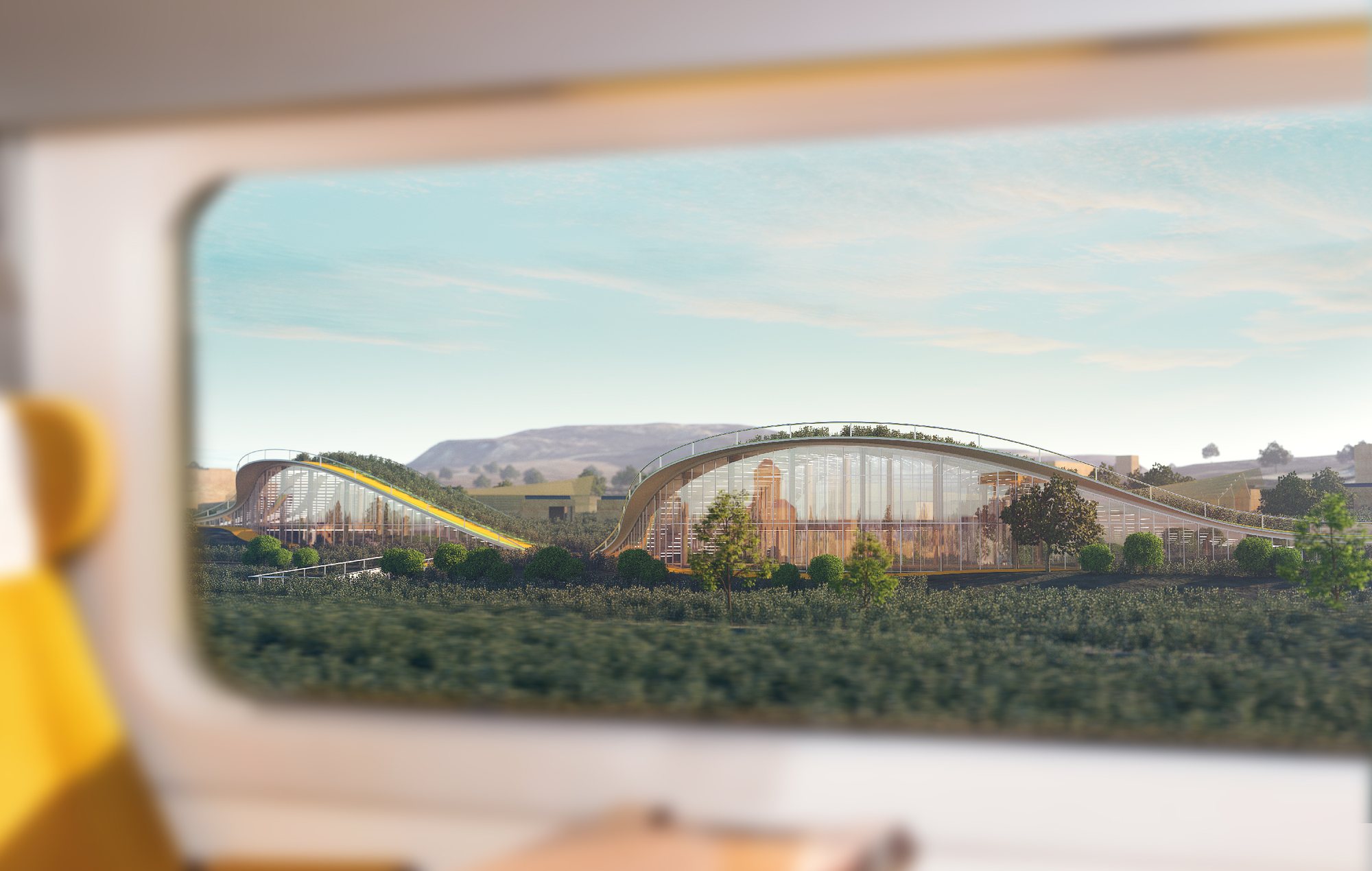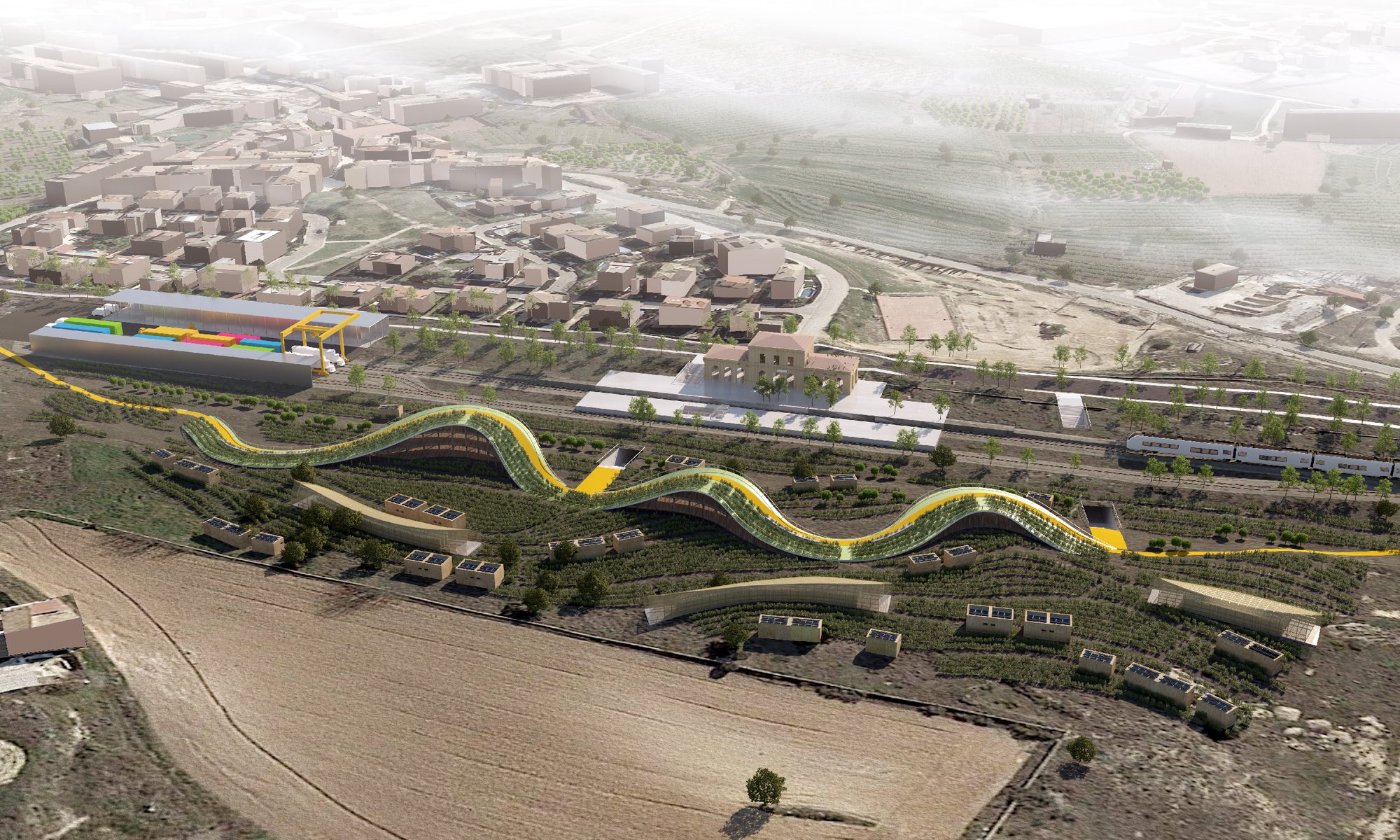
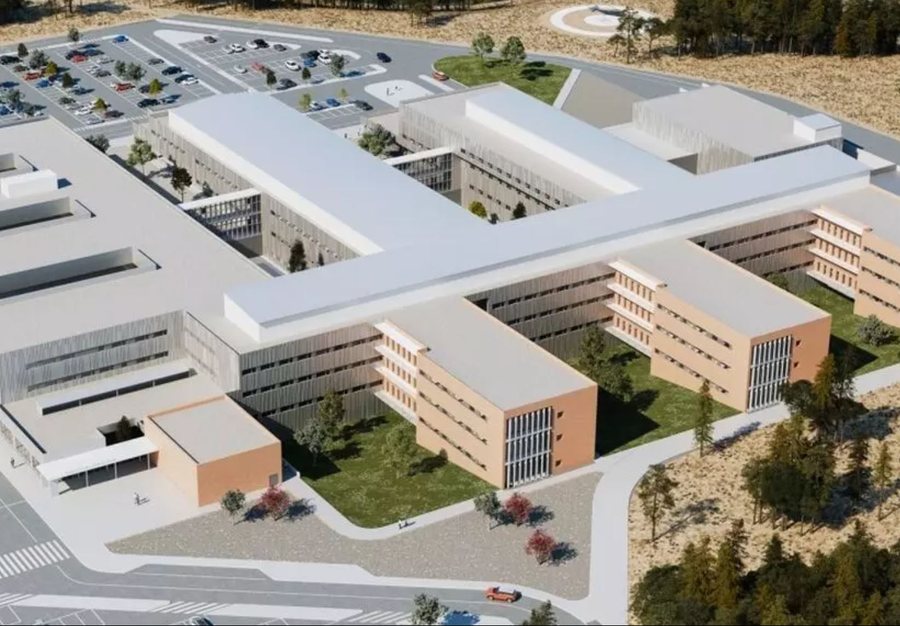
Aerial view of the Smart Regional proposal next to the old Alcañiz station

The Lab · Smart Geoanalysis

Smart Regional - Alcañiz

A recovery package for Alcañiz and its region: the old railway reopened with a hydrogen train, a logistics hub at the station, and new places to work, live and research among the vineyards.

TYPE

Masterplan & infrastructure

LOCATION

Alcañiz, Aragón, Spain

IMPACT

96,000 people within 60 min

CLIENT

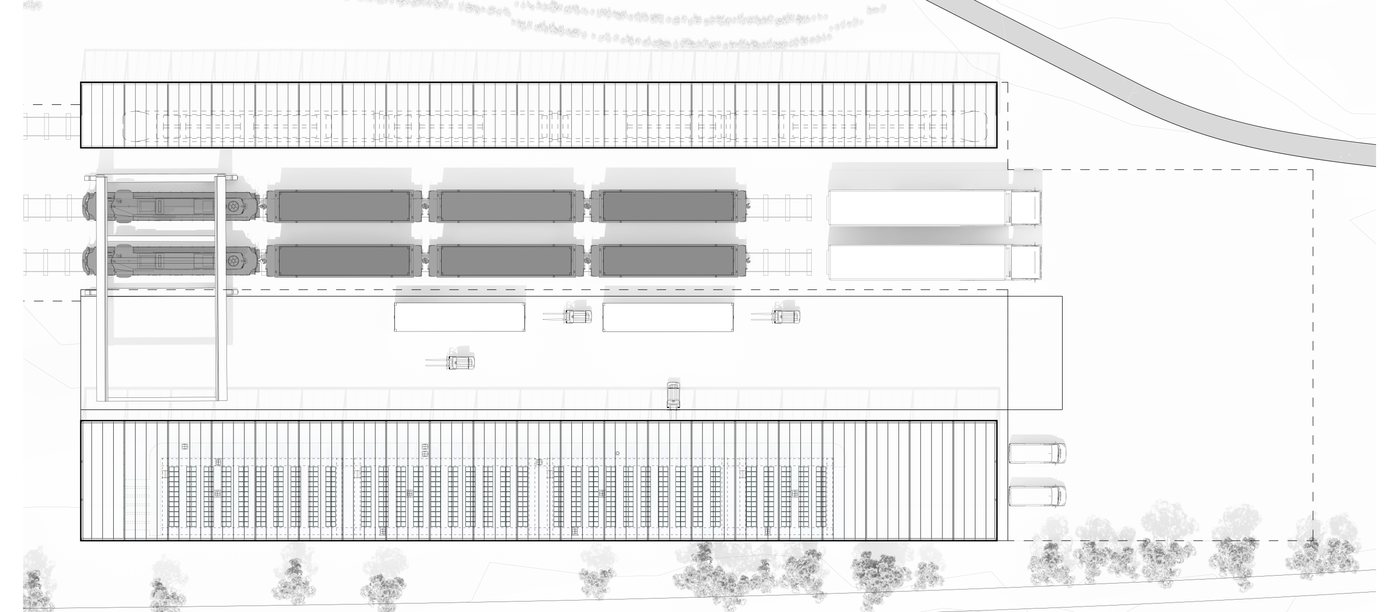
Smart Regional Spain

Why Alcañiz

Alcañiz has about 16,400 inhabitants, 52% of its county, and a GDP of €460 million. Within a 60-minute drive live 96,000 people across 92 municipalities. It sits between Spain's main economic centres and already holds most of the county's administrative, health, legal and commercial services. Its railway station opened in 1895 and closed in 1973.
Fig. 01

Restoring rural railways

Alcañiz as the regional hub, with three satellite towns along a reopened hydrogen train line.
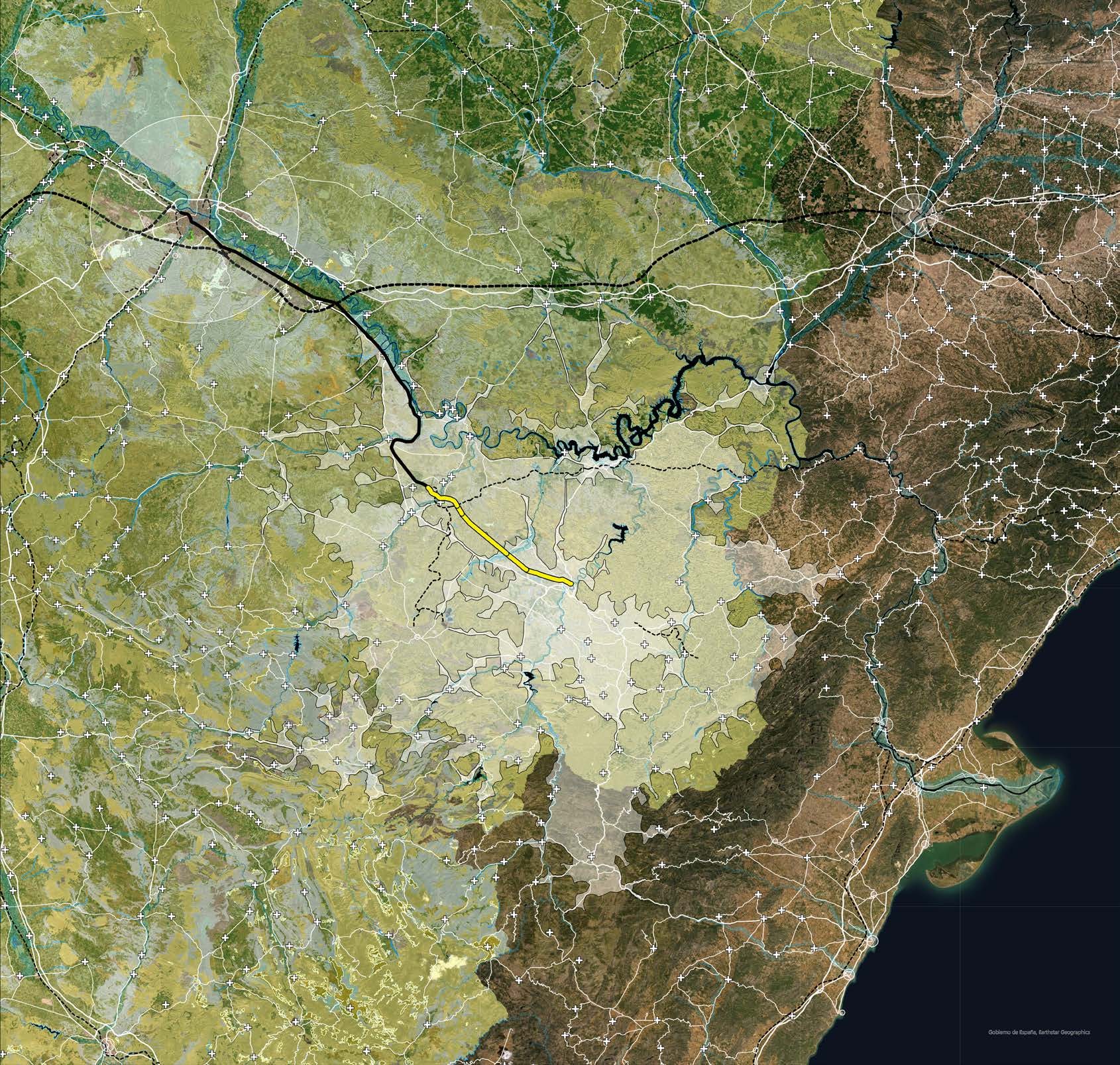
Hubs

  • Regional hub
  • Satellite hub
  • Town under 5,000
  • Hydrogen train line

Land use

  • Forest and agroforestry
  • Agriculture
  • Pastureland

Within 60 minutes by car

People
96,203
Municipalities
92
Andorra
8,367
Caspe
8,000
Calanda
4,004
Alcorisa
3,642
Gandesa
3,222
Valderrobres
2,290
1,725 MWof renewable energy planned around Alcañiz as Endesa converts the Andorra coal plant
5%of Aragón's GDP comes from logistics and transport, employing 30,000 people
95%of inland transport in Aragón moves by road, only 5% by rail
Fig. 02

A hydrogen train

Local hydrogen makes it possible to reopen the line with a fuel-cell train. Each car carries its own set of components; the numbers on the train match the steps below.

  1. Hydrogen tankFilled with high-pressure hydrogen, at each end of the train.
  2. Fuel cellCombines the hydrogen with oxygen from the air to generate electricity.
  3. ConverterA DC/DC converter conditions the power for the main circuit and the auxiliary power supply.
  4. BatteryThe main circuit storage battery charges and discharges to balance the load.
  5. Traction motorPower conversion equipment drives the motors and the wheels. The only waste is water.
The Program Set

Smart Regional reactivates towns with over 10,000 inhabitants, far from commercial hot spots, that can recover an abandoned railway. Nationally, the line links the town back to Zaragoza, Madrid and Barcelona; regionally, a set of programs around the old station brings growth to the town and the villages around it. The set is adapted to each place, but its parts can be repeated in other regions.
Fig. 03

Program set and stakeholders

National development reconnects the town to Zaragoza, Madrid and Barcelona; regional development links Alcañiz to the towns around it through three programs.
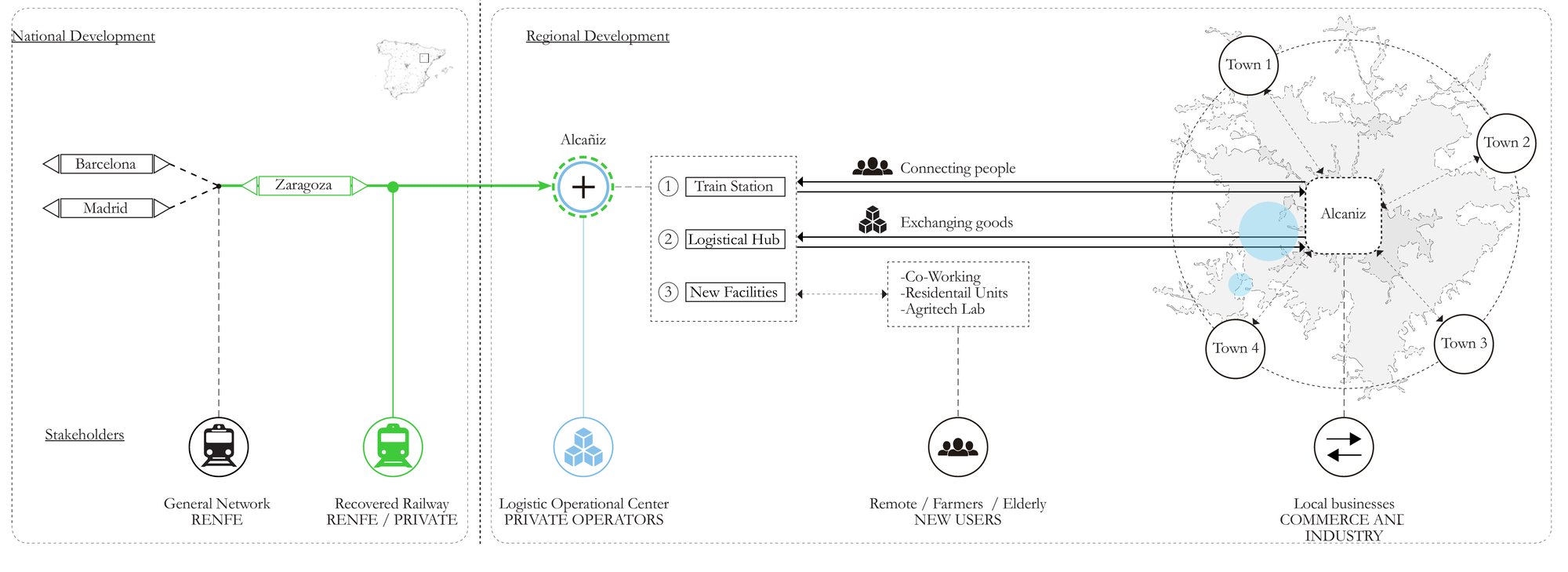
  1. Train stationReopening the railway to restore trade and social ties. Connects people.
  2. Logistics hubThe point where goods are exchanged between the towns and the cities.
  3. New facilitiesA co-working centre for remote workers, residential units that pair local tradition with an urban lifestyle, and an agricultural lab.

Stakeholders

General rail network
RENFE
Recovered railway
RENFE or a private operator
Logistics operations centre
Private operators
New users
Remote workers, farmers and older residents
Local businesses
Commerce and industry

Regional catalysts

Endesa's renewable plants
Endesa is converting its coal plant in Andorra, near Alcañiz, to renewable energy.
Mudéjar solar
1,585 MW
Iberos wind
139 MW
Andorra hydrogen
60 MW
Sedeis solar
40.56 MW
Fig. 04

Why Alcañiz

Reasons to live there and reasons to invest.
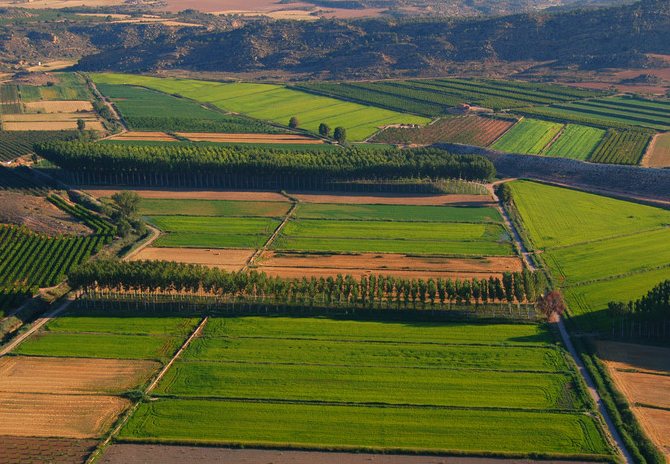
To live

Rural landscape

With 56% of the world's people in cities and rising, rural living is becoming more exclusive, with real benefits for health and lifestyle.
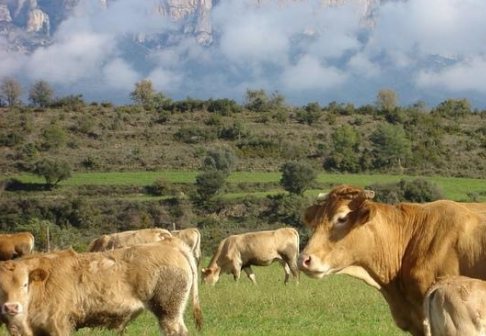
Gastronomy

The region grows produce that sells at a premium in city restaurants, and is eaten locally at a fraction of the price.
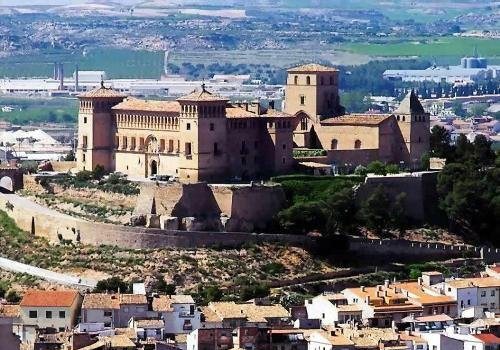
Historic value

Alcañiz dates back to Islamic Spain, and Christian, Muslim and Jewish communities all left their mark.
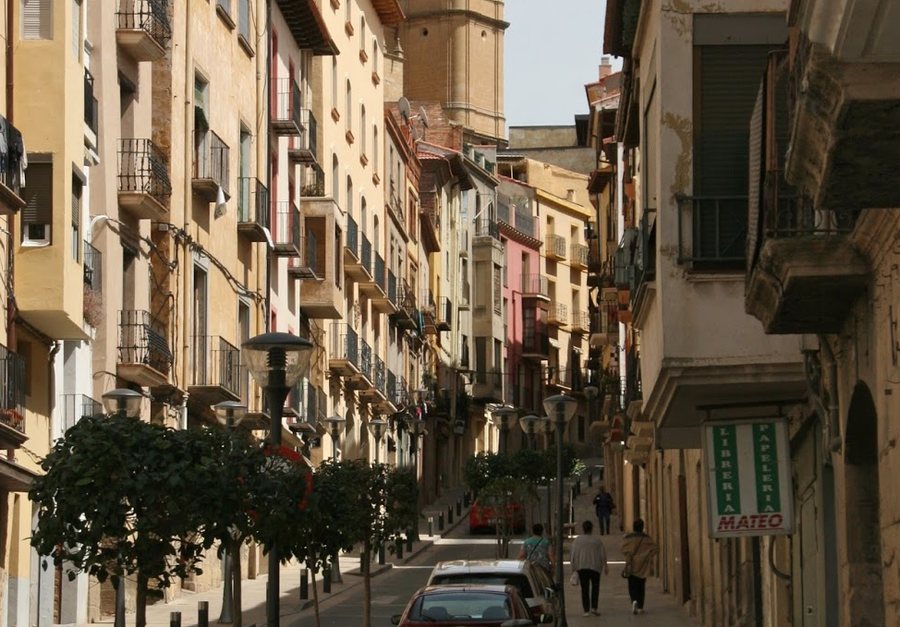
Safety and services

Low density and open space proved safer during Covid-19. A new hospital is being built, and Zaragoza is close.
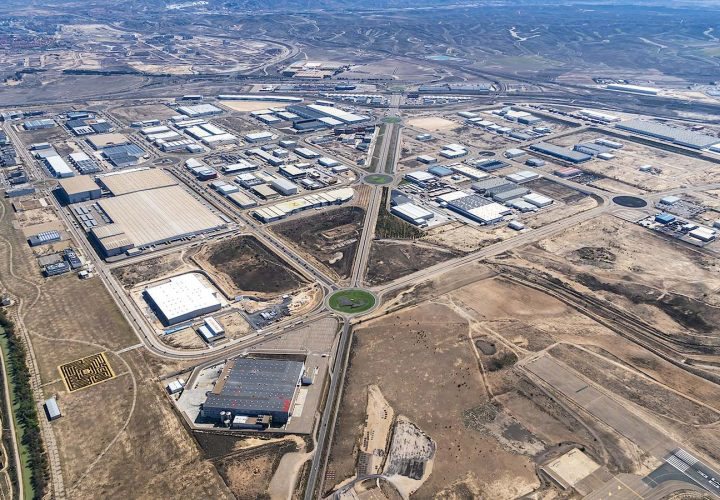
To invest

Strategic location

Zaragoza 110 km, Tarragona 140 km, Valencia 220 km, Barcelona 260 km, Madrid 340 km: the base for a fast logistics network.

Economic structure

Services make up 41.6% of the economy, the primary sector 22.8% and industry 20.9%.
Population

52% of the county lives in Alcañiz, almost 16,000 people with a GDP of €460 million.
Public facilities

Most of the county's administrative, health, legal and commercial services are already here, ready to absorb growth.

A Network of Hubs

The logistics hub brings city products and services to the region. A main hub sits next to the restored station and smaller town hubs are spread through the centre of Alcañiz, working as click-and-collect points for residents and businesses. The same model extends to nearby towns such as Valderrobres.
Fig. 05

Territorial application

The old station hub and three town hubs in Alcañiz, and the extension to Valderrobres.
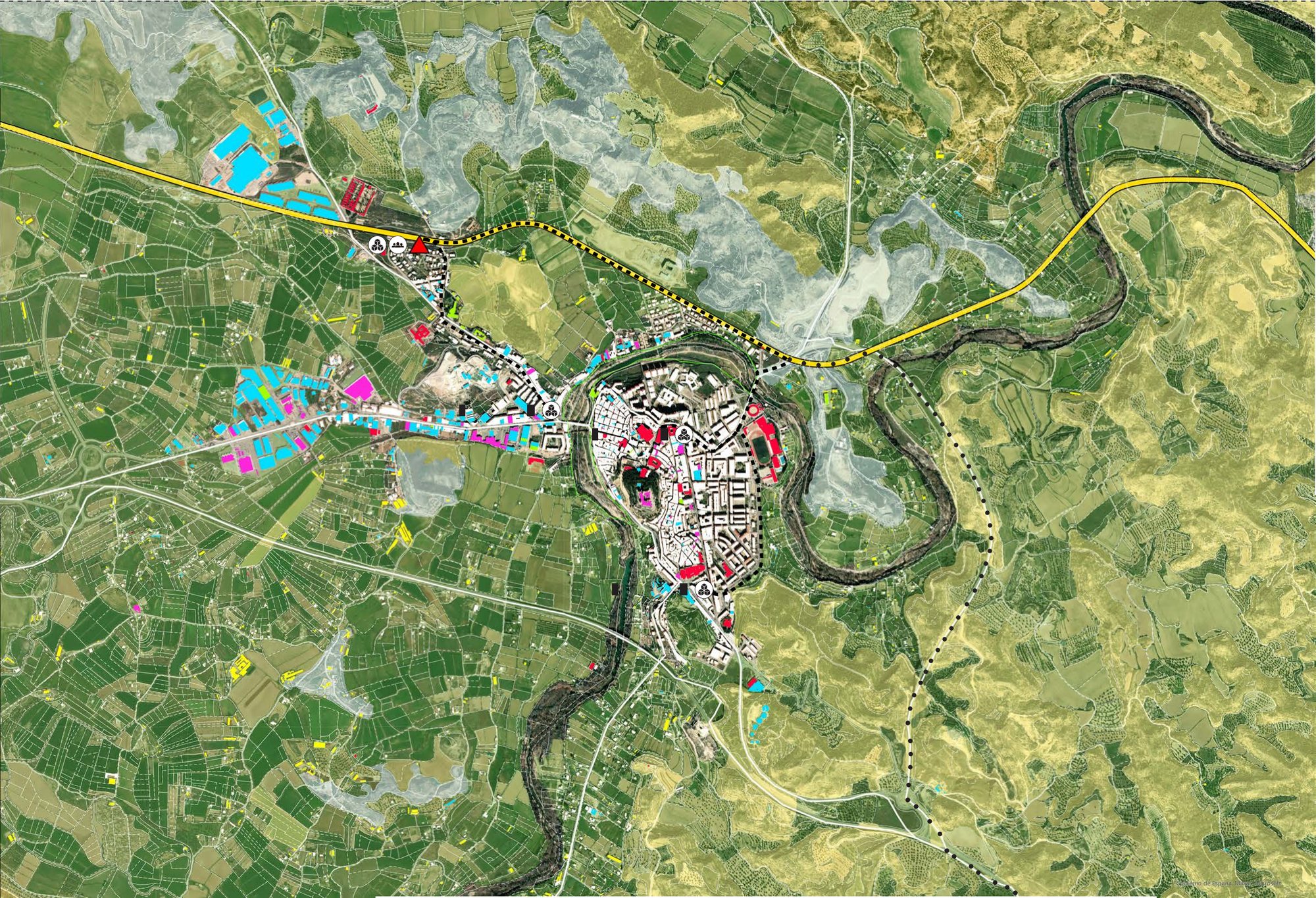
Program

  • Residential
  • Industrial
  • Retail
  • Agriculture
  • Public space
  • Other

Logistics

  • Hydrogen train line
  • Town distribution
  • Valderrobres distribution

Land use

  • Forest and agroforestry
  • Agriculture
  • Pastureland

Valderrobres

The same model in a satellite town of 2,290 people: a town hub in the centre, linked to Alcañiz by its own distribution route.

Fig. 06

Urban application

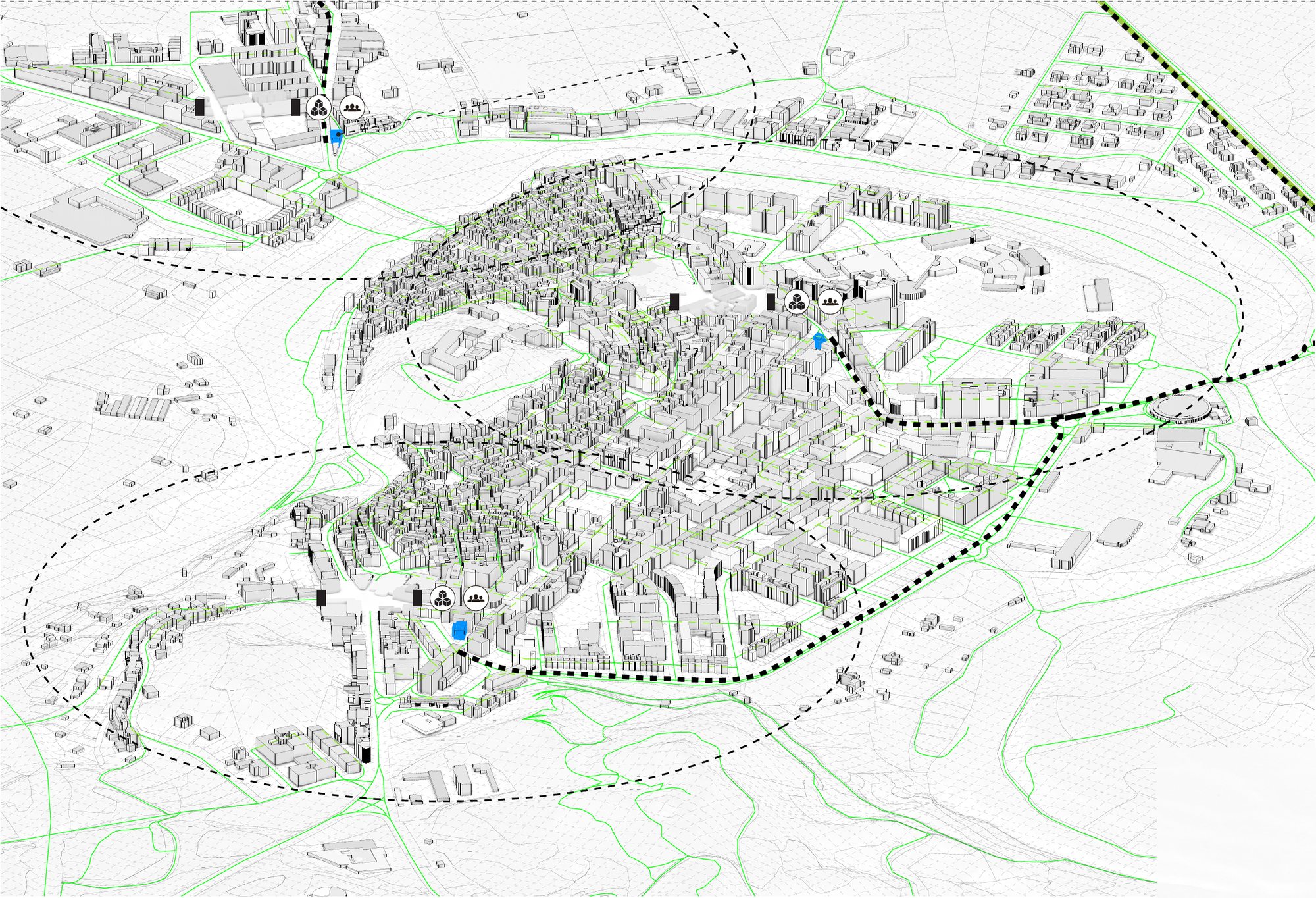
The old station and the town centre, each hub serving the area around it.
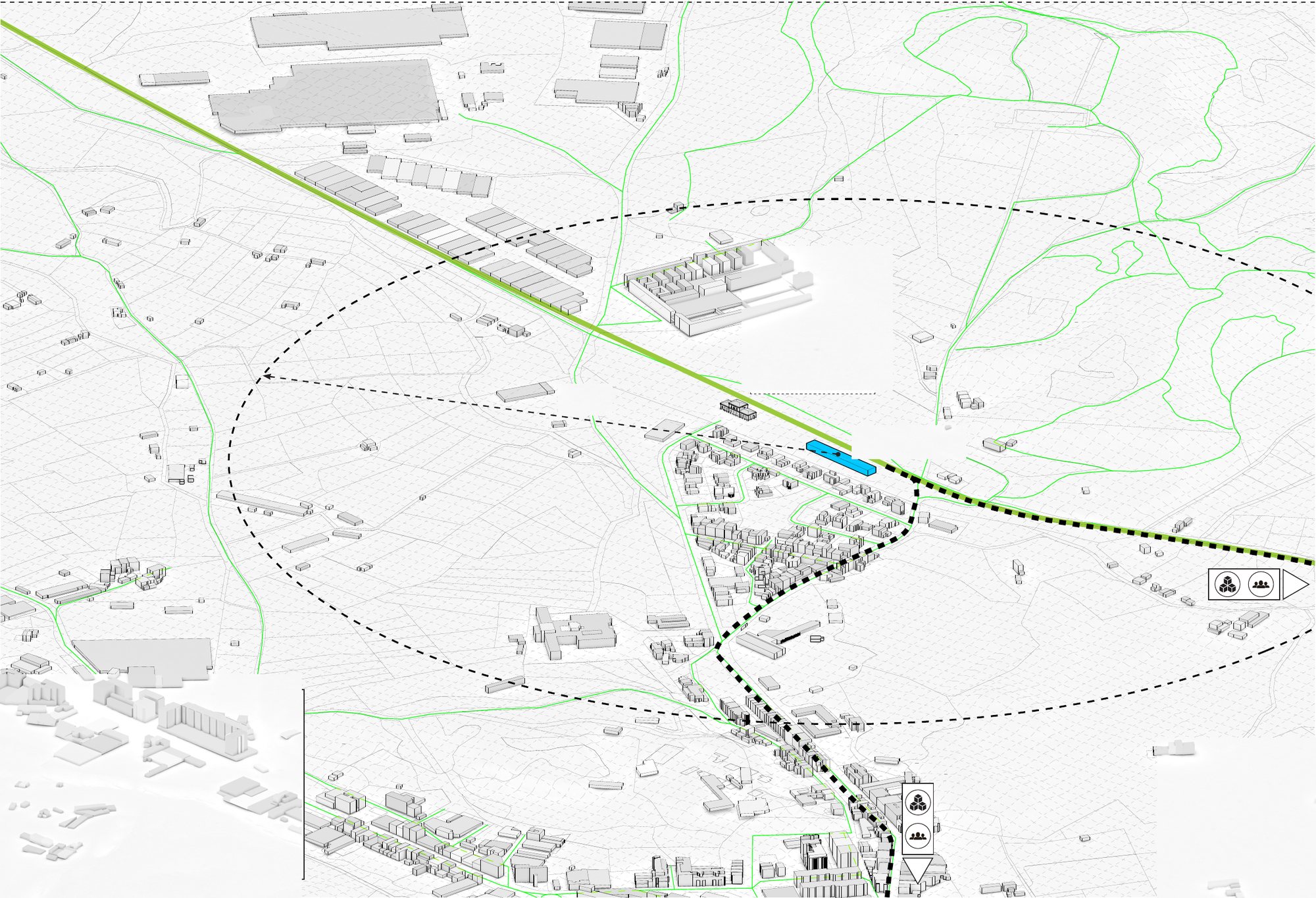
Hubs

  • Logistics warehouse
  • Connecting people
  • Click and collect, warehouses

Network

  • Hydrogen train line
  • Future extension
  • Last-mile logistics network
  • Area served

Alcañiz station

  • 1895Opens, run by FZM until 1898
  • 1899–1941Estado / EFE
  • 1941–2005RENFE
  • 1973Closes
  • 2005–todayAdif
Architecture with the Landscape

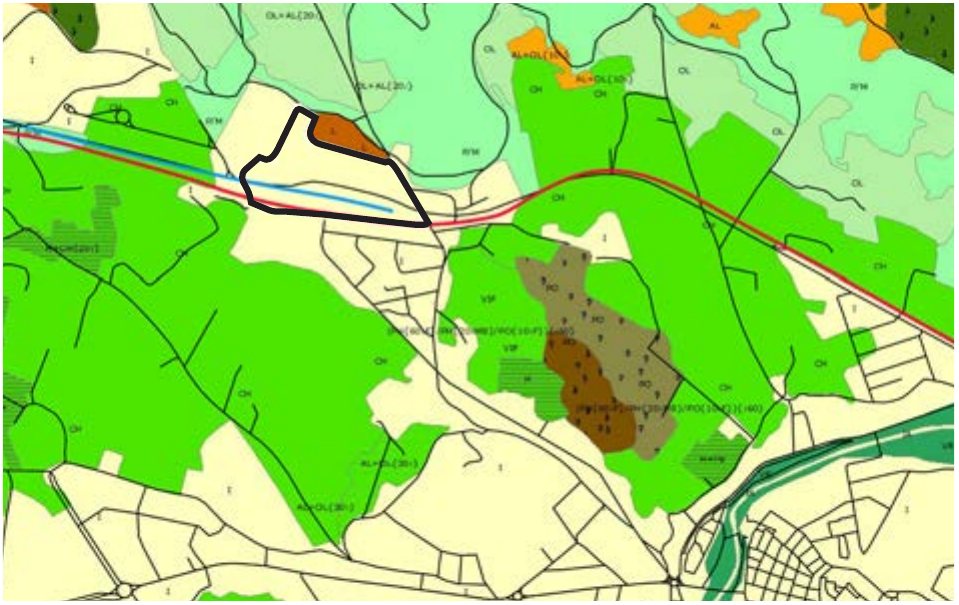
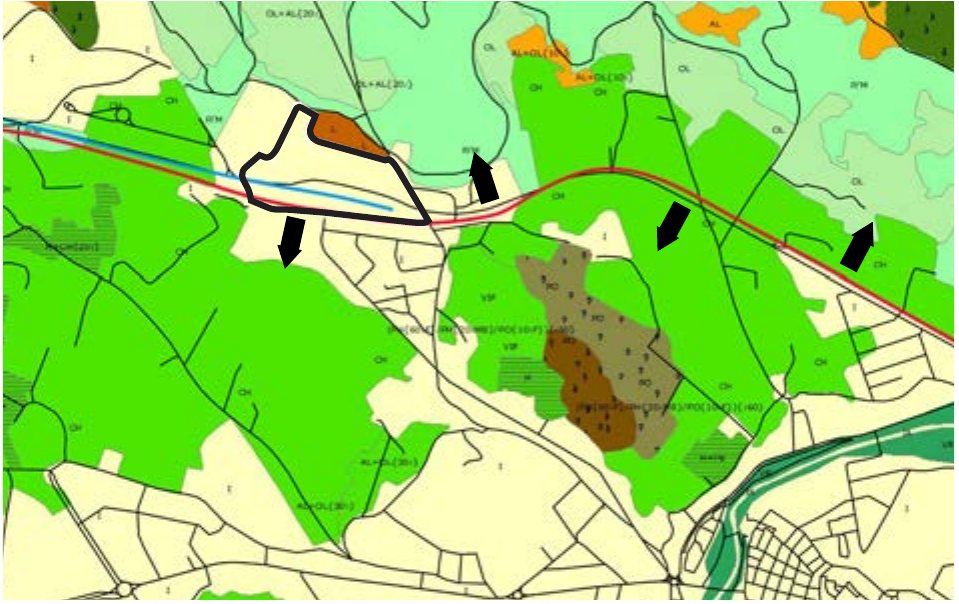
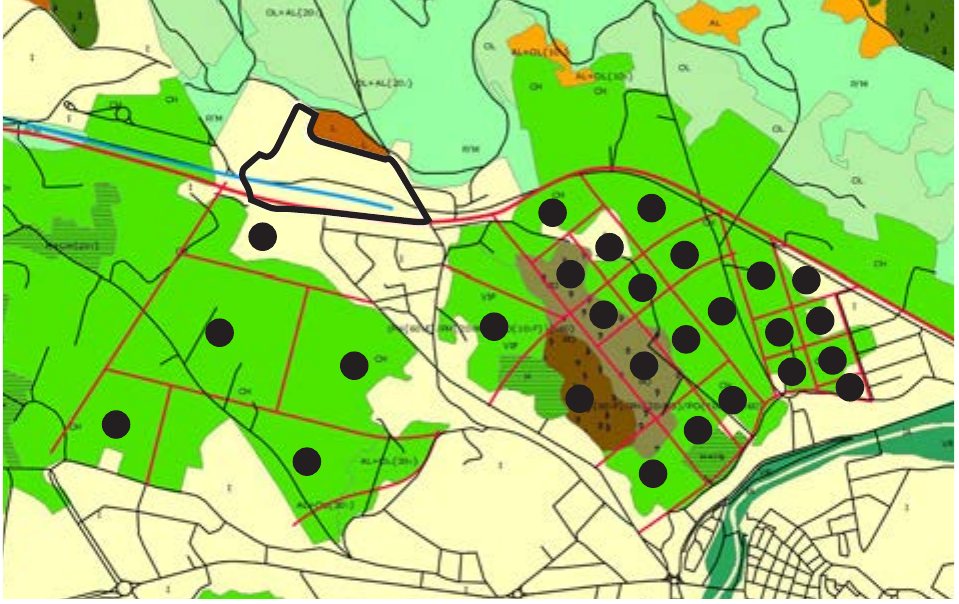
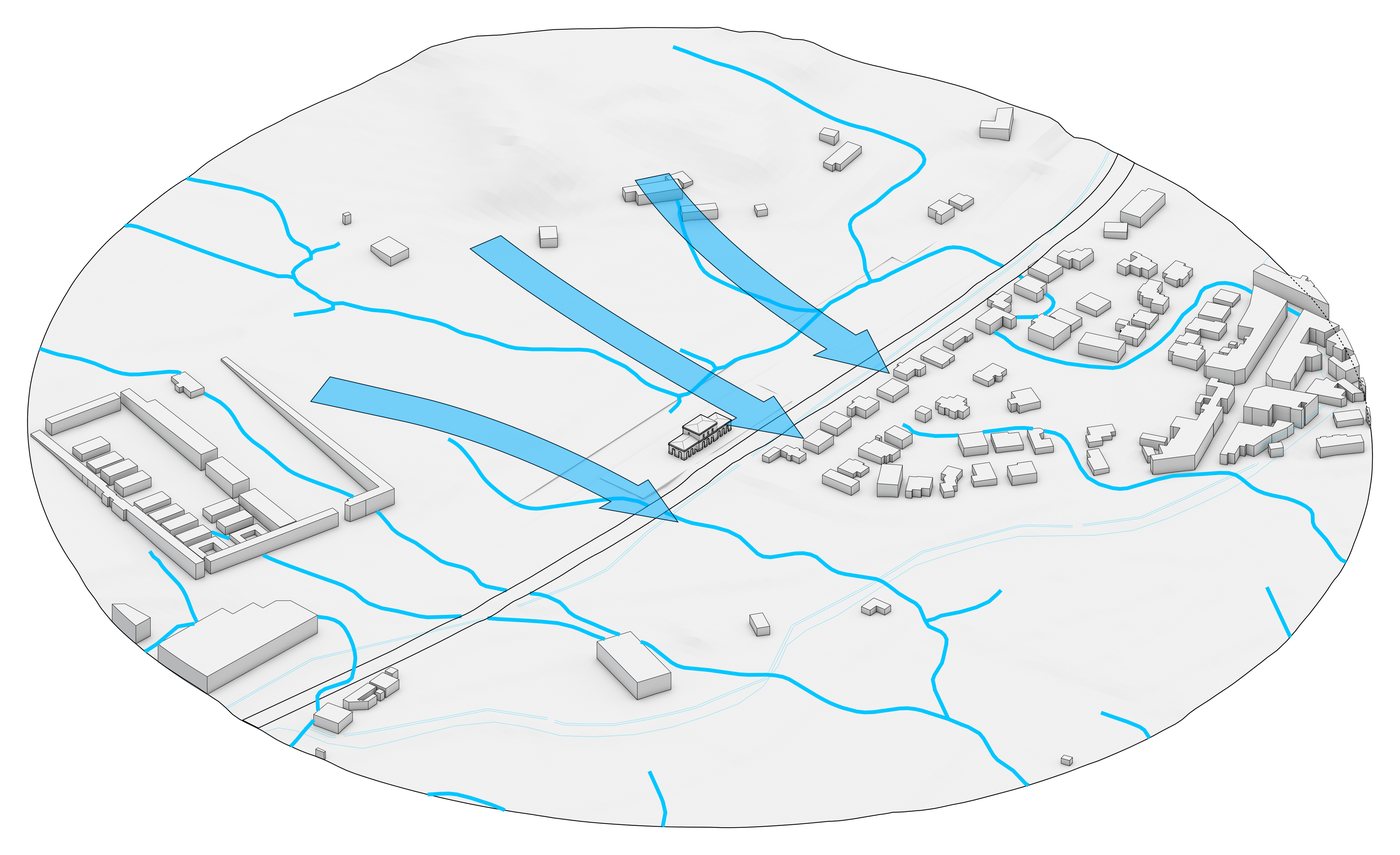
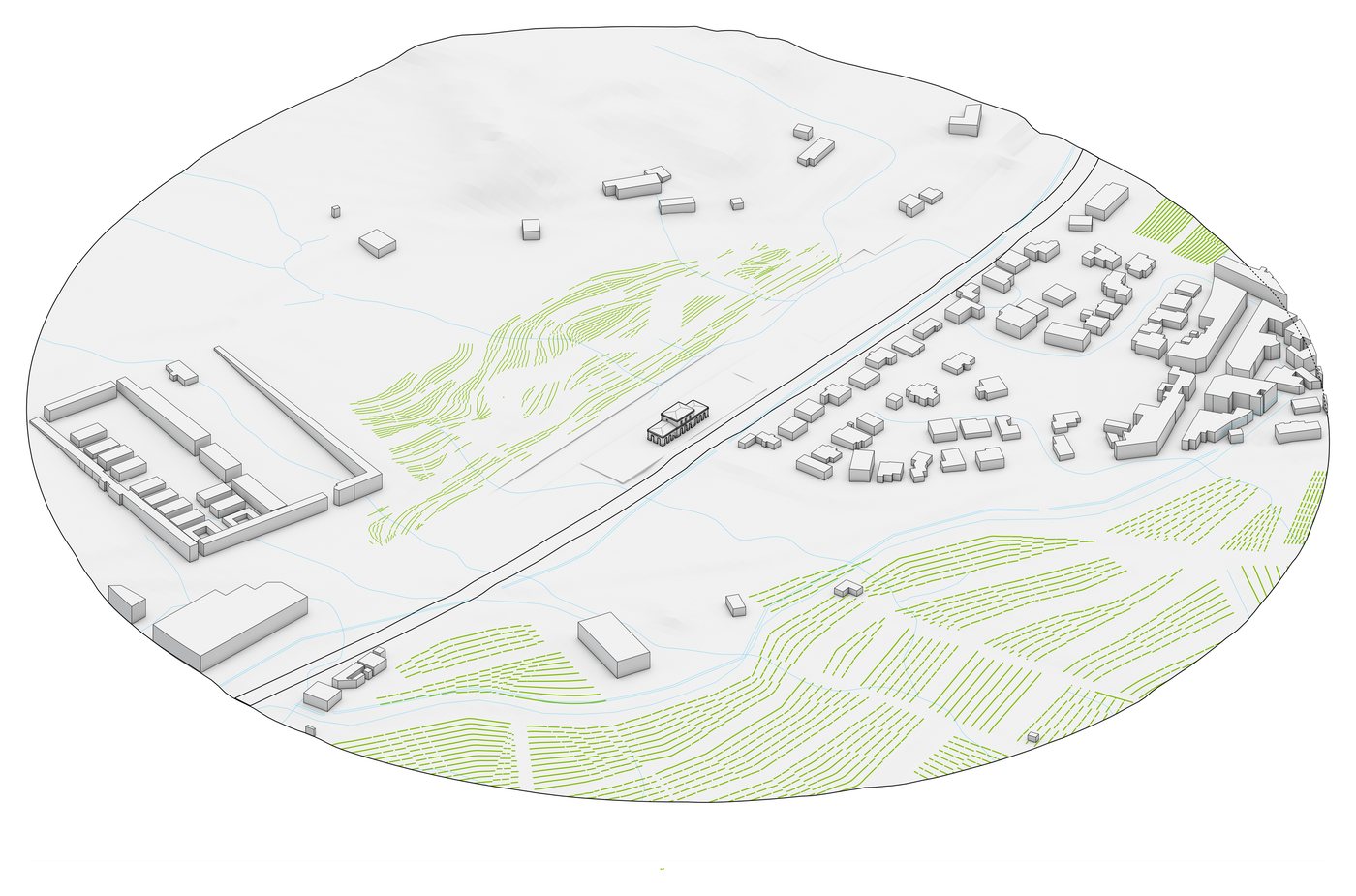
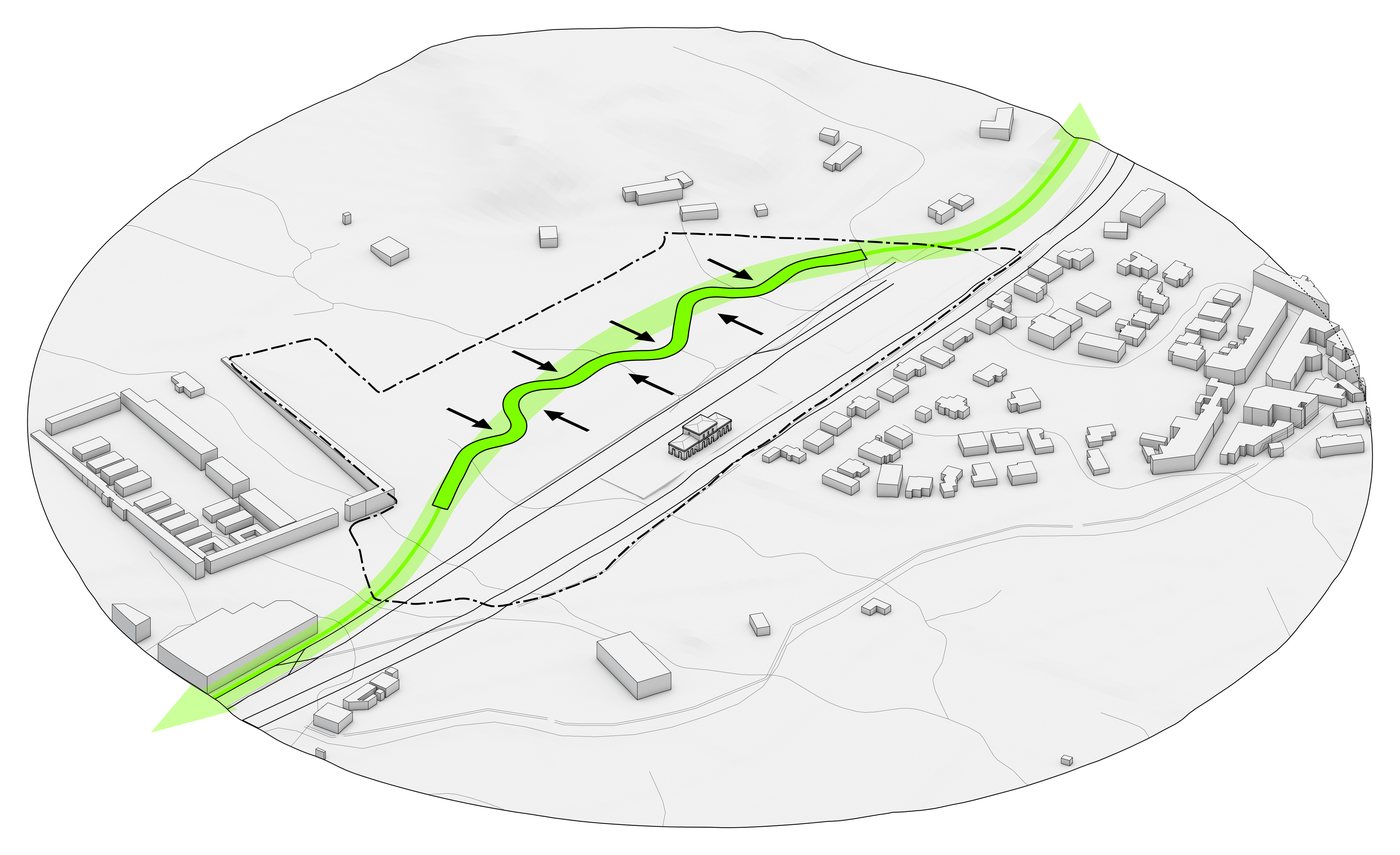
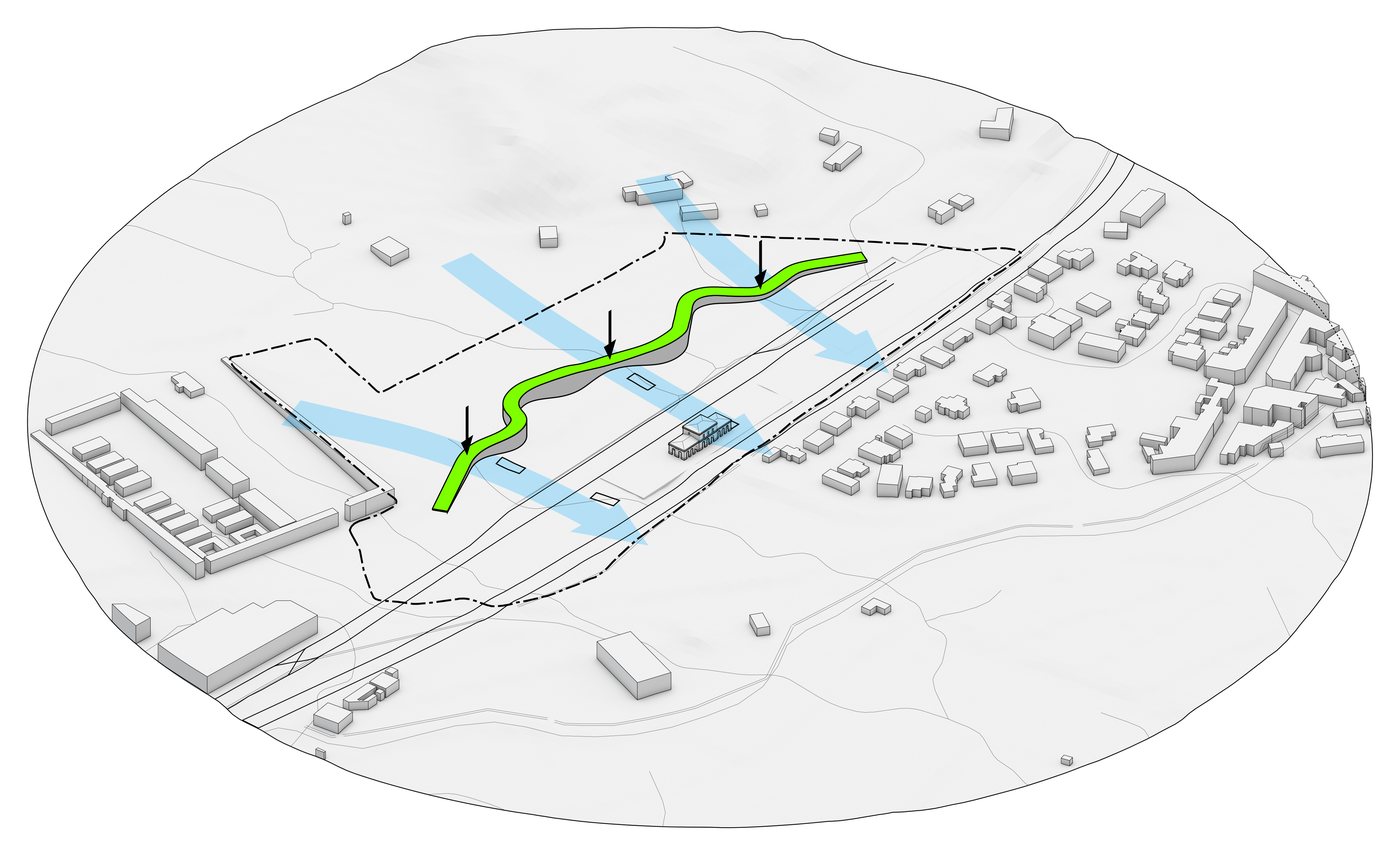
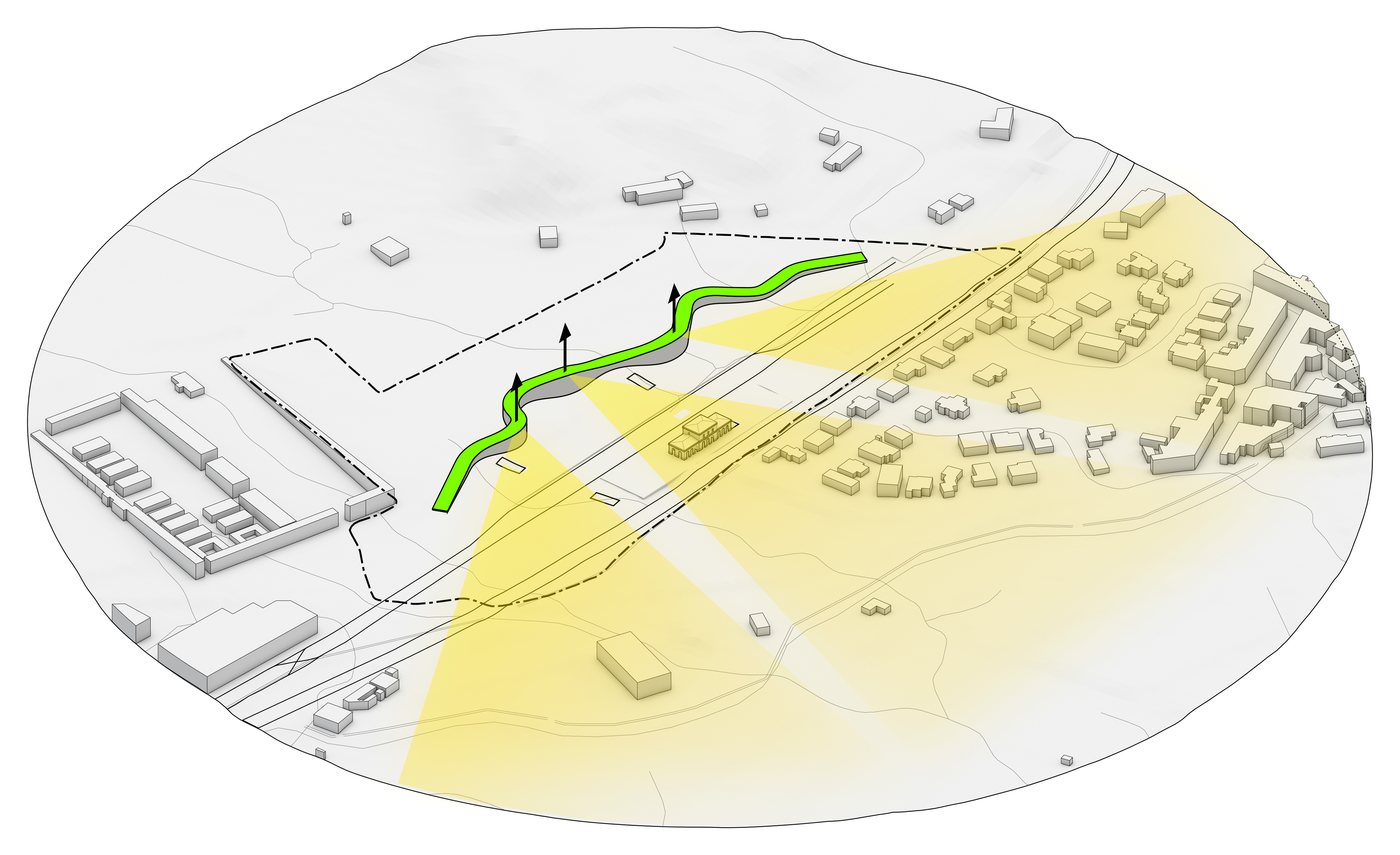
Railways and new developments act as boundaries that cut the land off from its natural cycles, and the town's future urban plan (PGOU) would cover crops that give the region its identity. The proposal works the other way: it builds natural bridges under the railway so water can pass, and replants on the plot the crops the expansion would remove.
Fig. 07

Infrastructure as a boundary

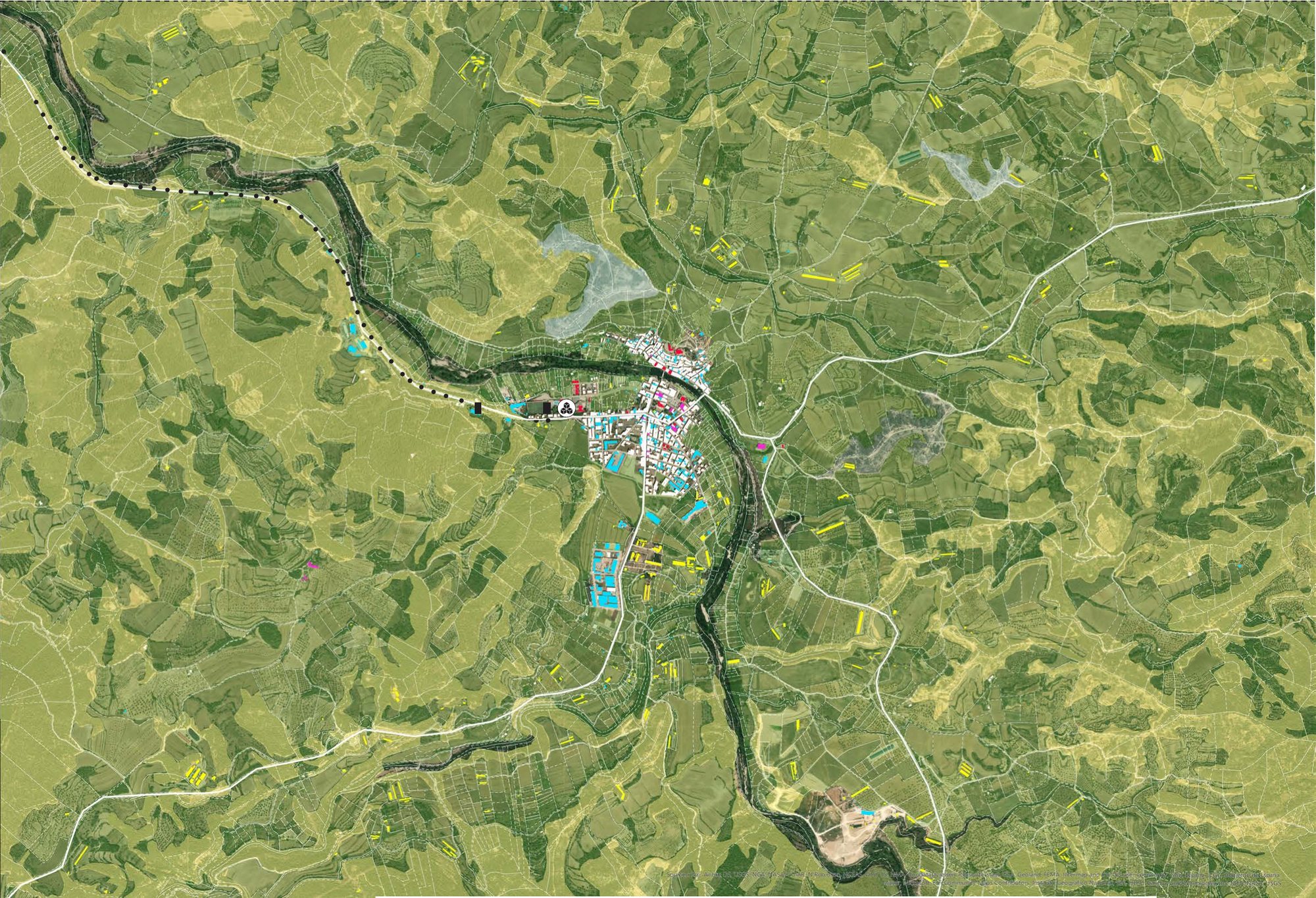
The site next to the station, surrounded by agriculture.
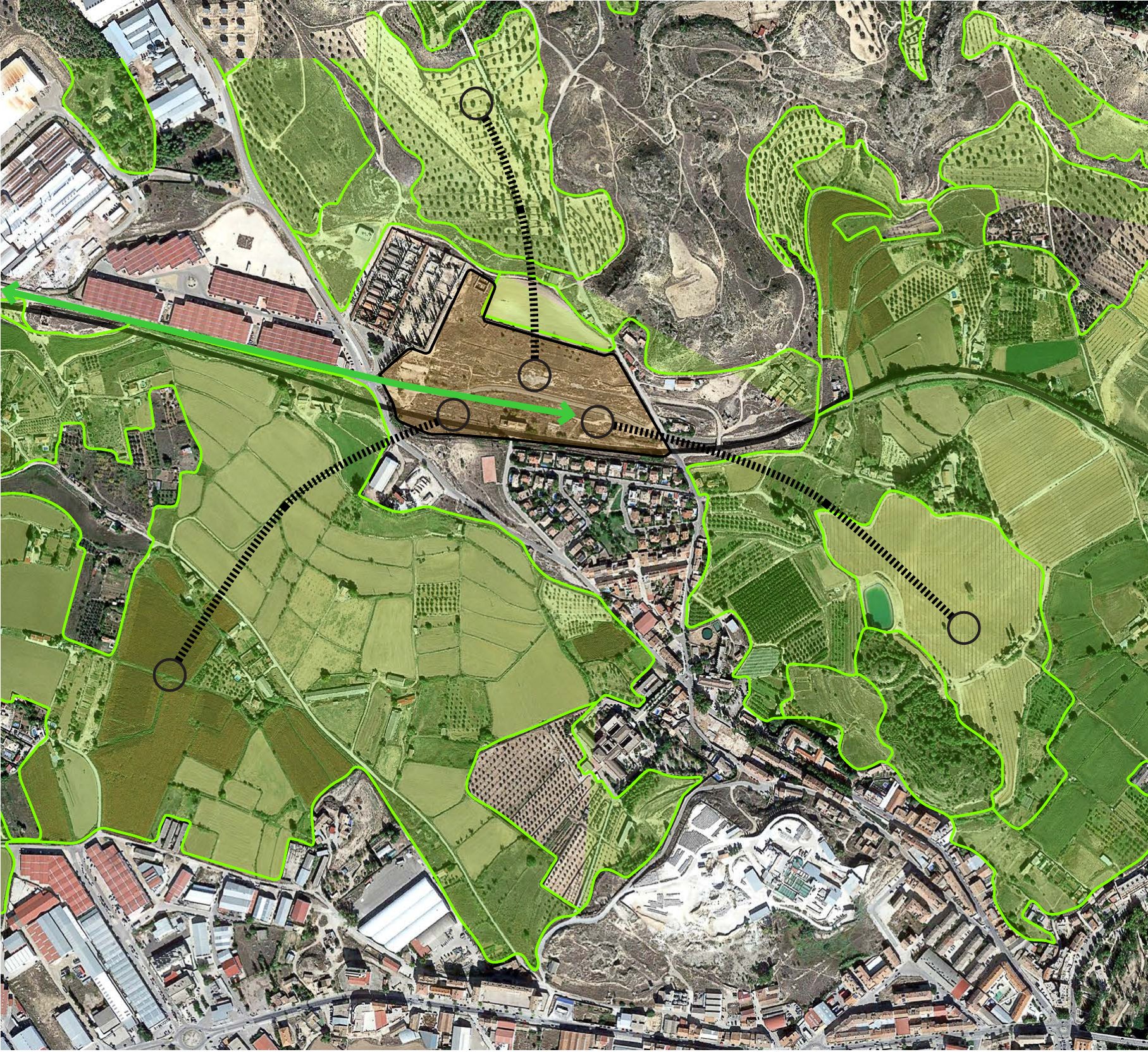
Fig. 08

Connecting landscapes

How the building follows the abandoned line and lets nature pass through it.
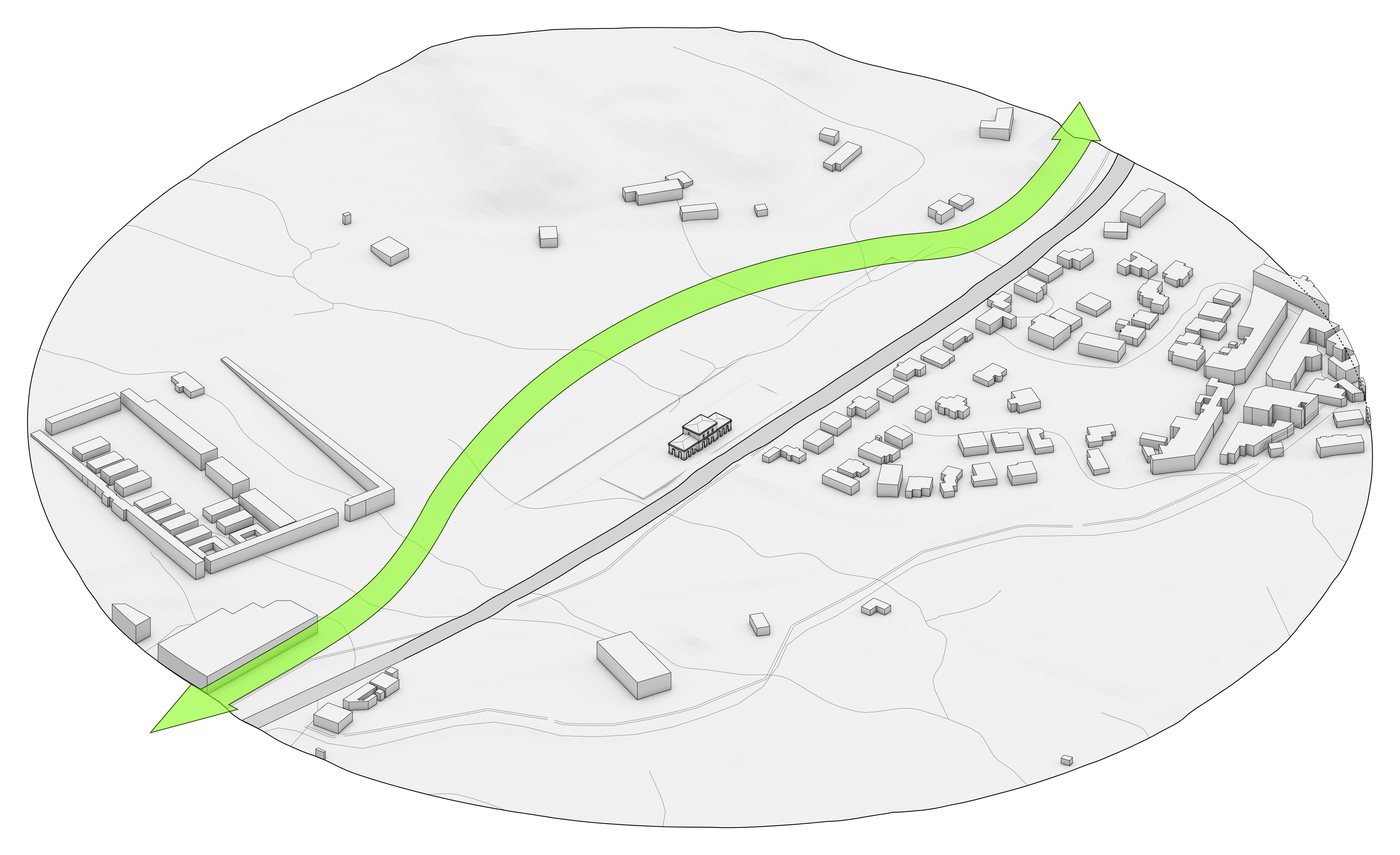
Fig. 09

Masterplan

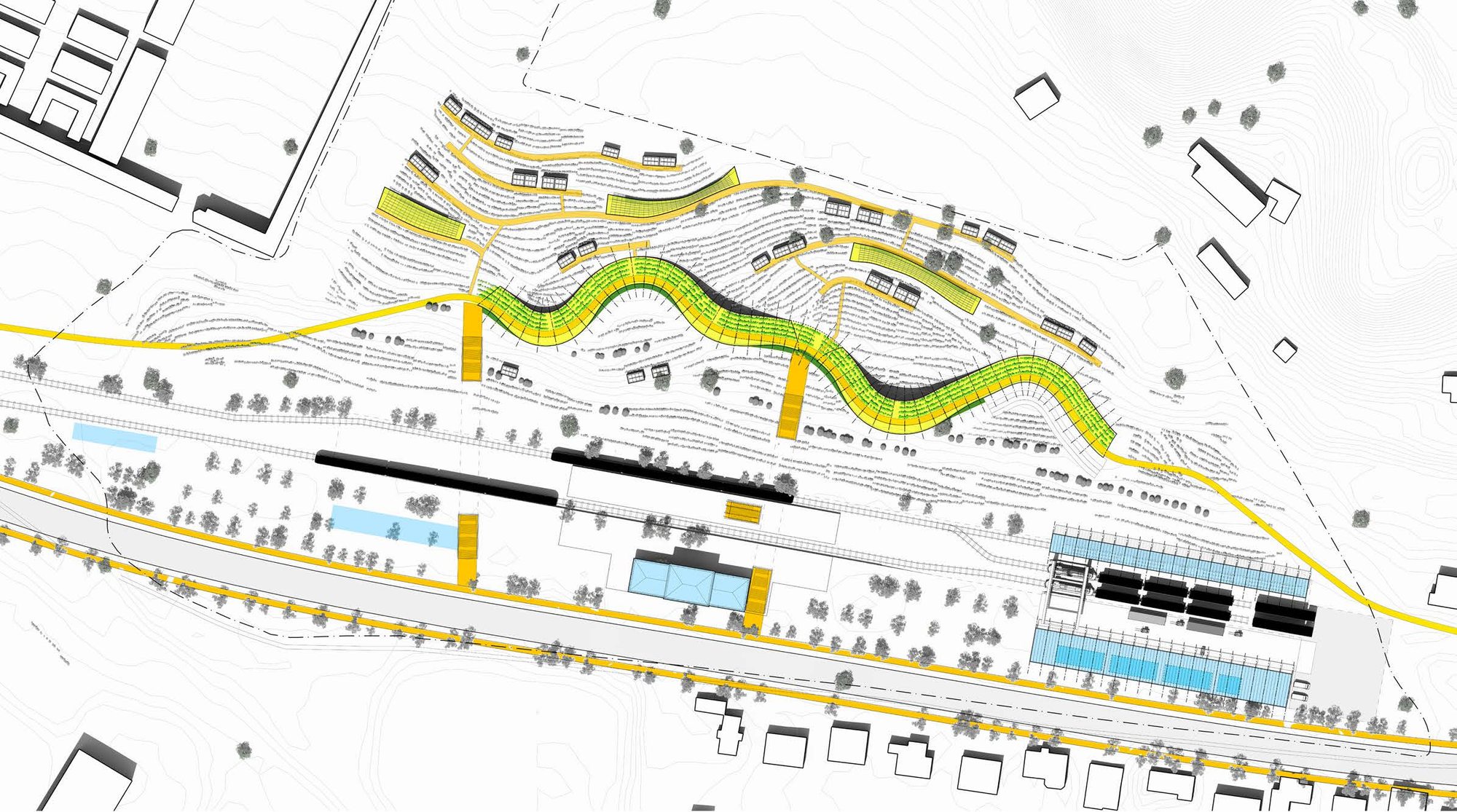
The program set distributed across the plot, beside the station and its railway yard.
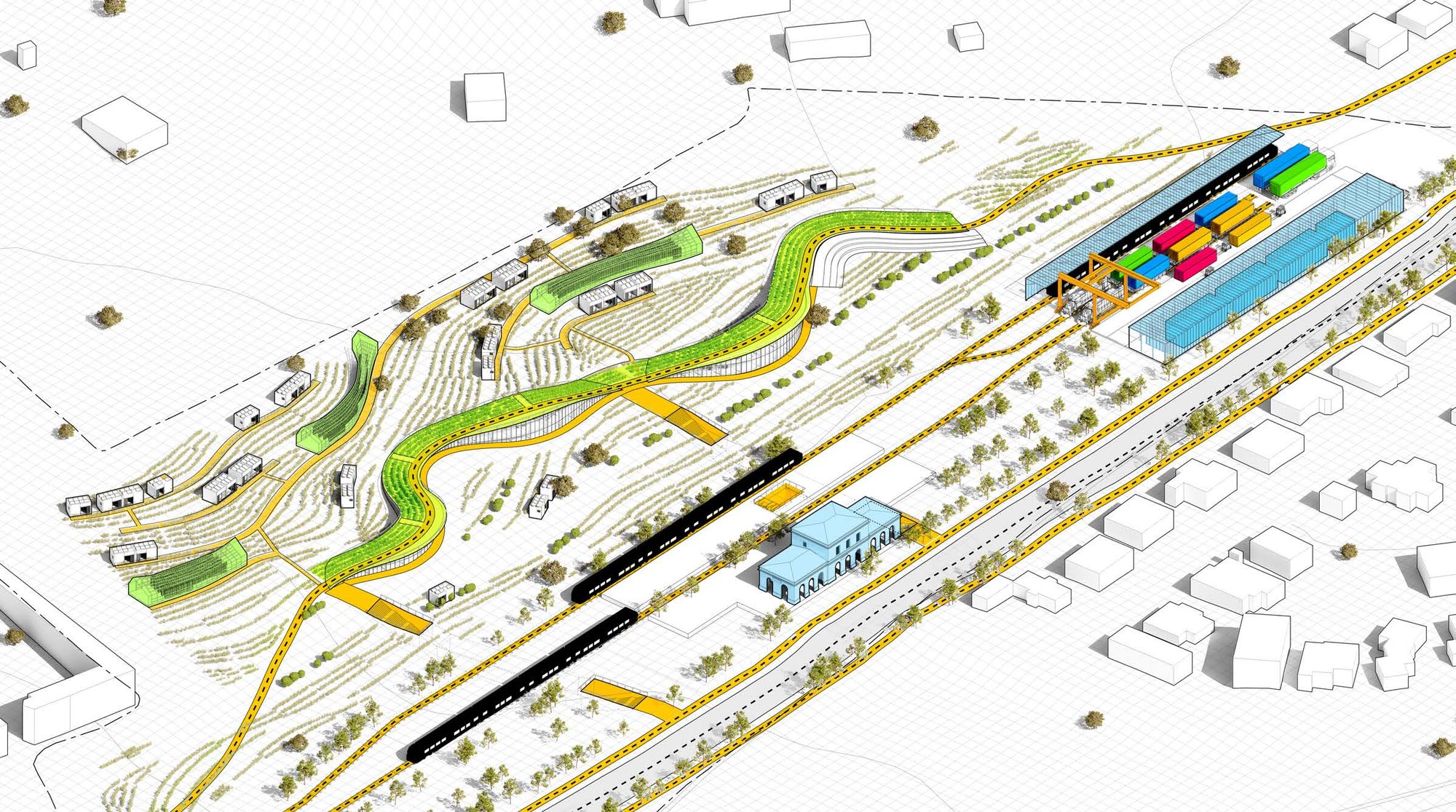
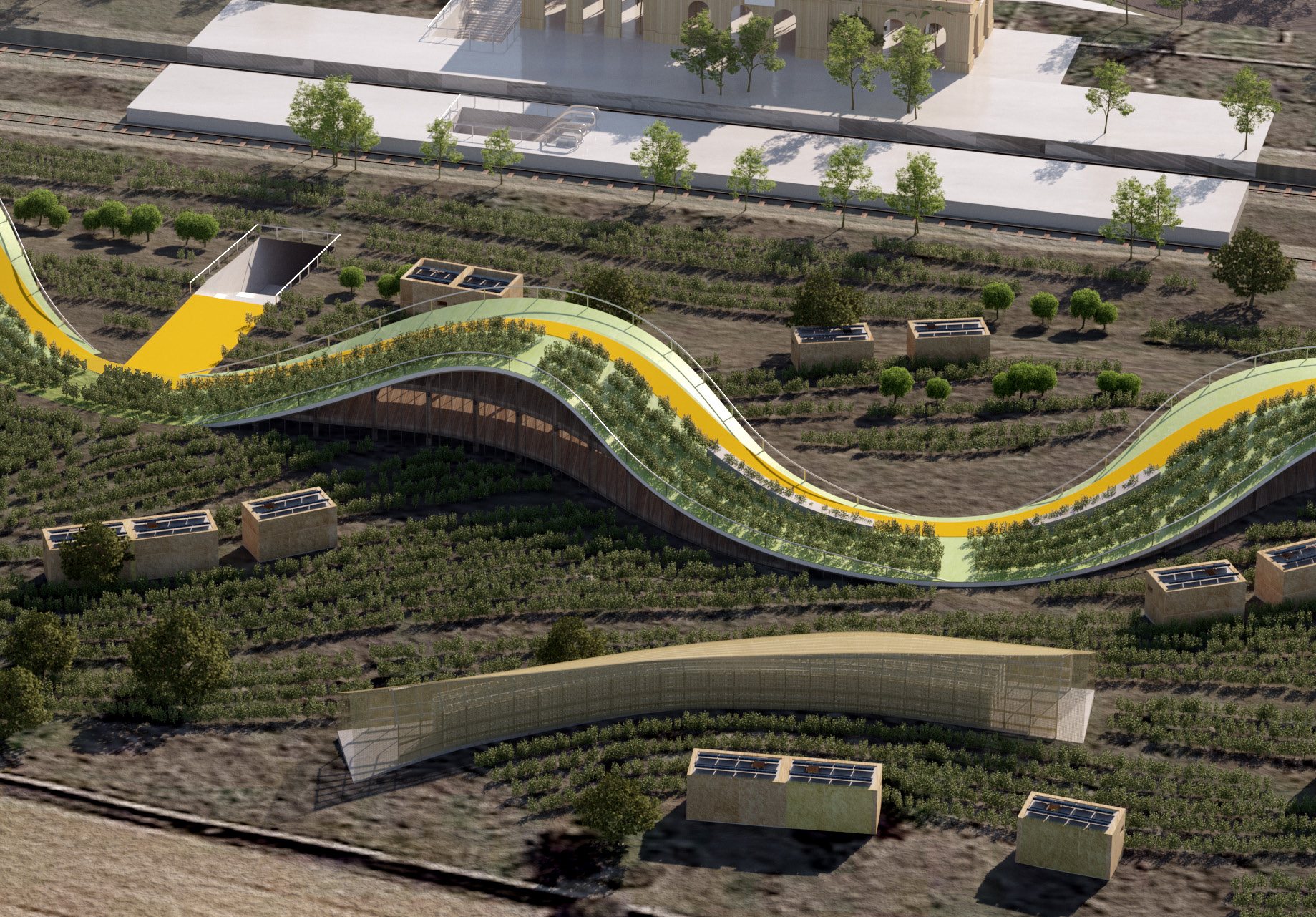
Fig. 10

Program set distribution

Cabins, greenhouses and the co-working centre among olive trees and vineyards, next to the train platform.
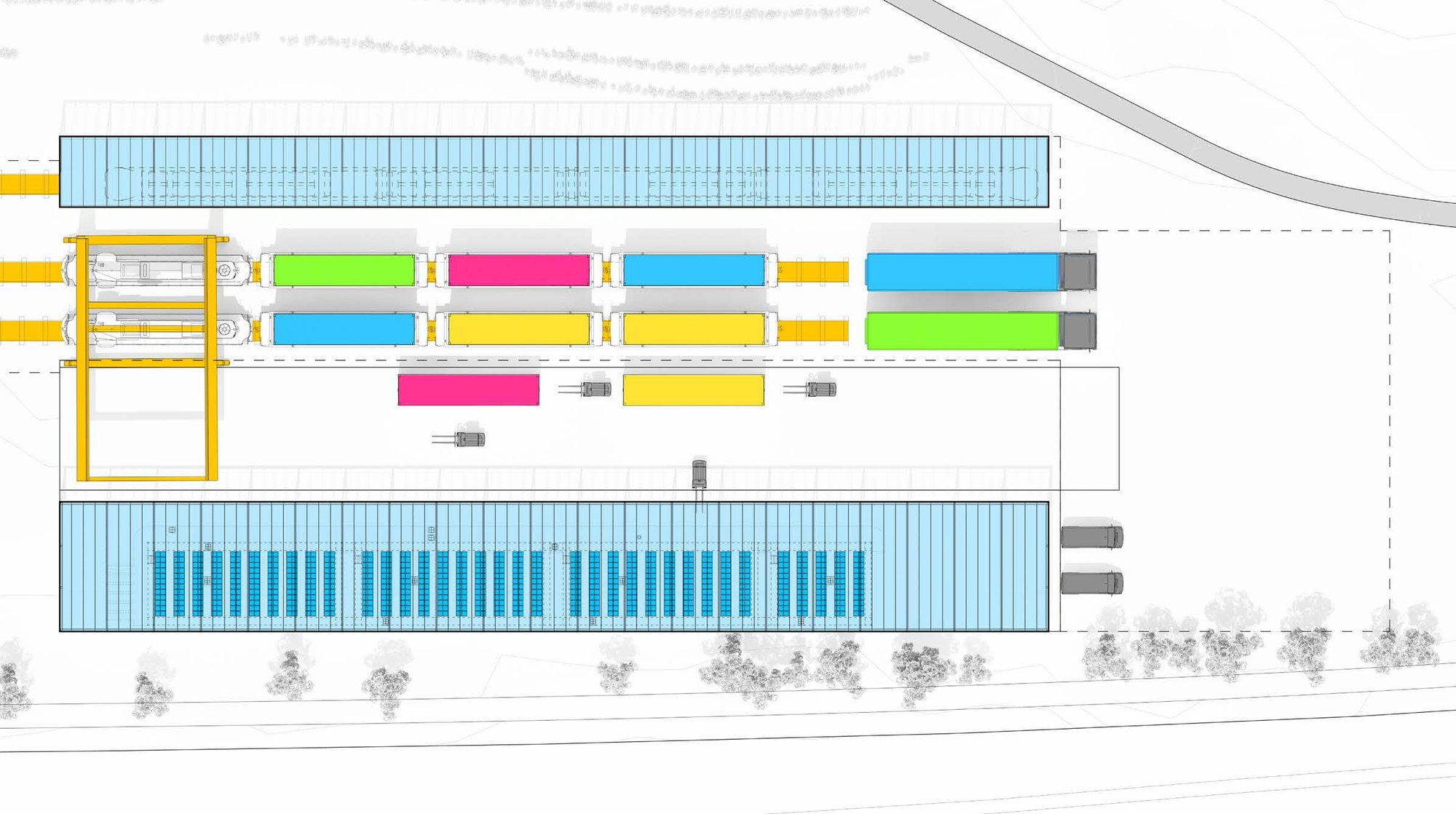
The Logistics Center

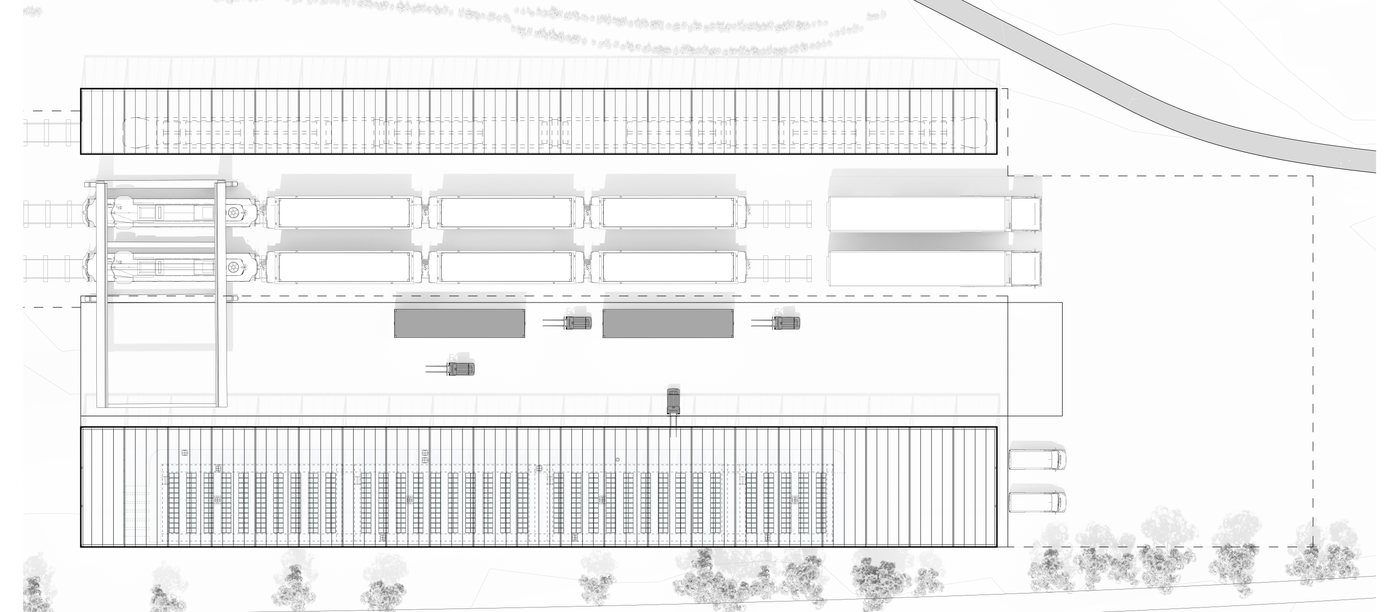
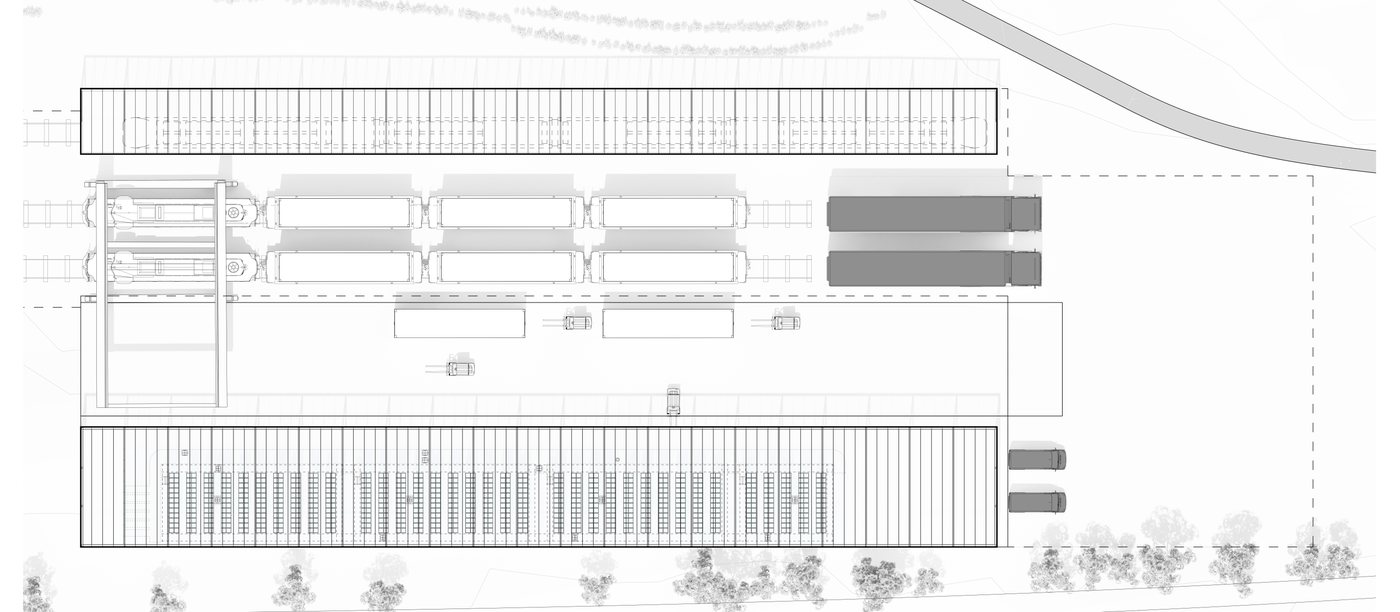
The logistics center is the engine of the program. It handles inbound freight, storage and sorting, and last-mile distribution, so the 96,000 people of the region gain access to goods that were only available in cities, and city residents gain access to the region's produce.
Fig. 11

Logistics center

Freight arrives by train, is stored and sorted, and leaves for the towns.
Co-Working Center

To attract the growing number of remote workers, the program includes a co-working centre in the middle of the vineyards: a working space that is well connected and within nature.
Credits

Commissioned by Smart Regional Spain | Infrastructures and Services.
Concept and authorship: Gabriel Muñoz Moreno, Dr. Holger Sprengel, Jordi Muro.
Lead architects: Gabriel Muñoz Moreno, Pratik Borse.
LAIA team: Pratik Borse, Francisco Alarcón, Oliver J. Curtis, Rafael García-Monge Pozo.